Antidepressants and Alcohol: Why This Combination Can Be Deadly
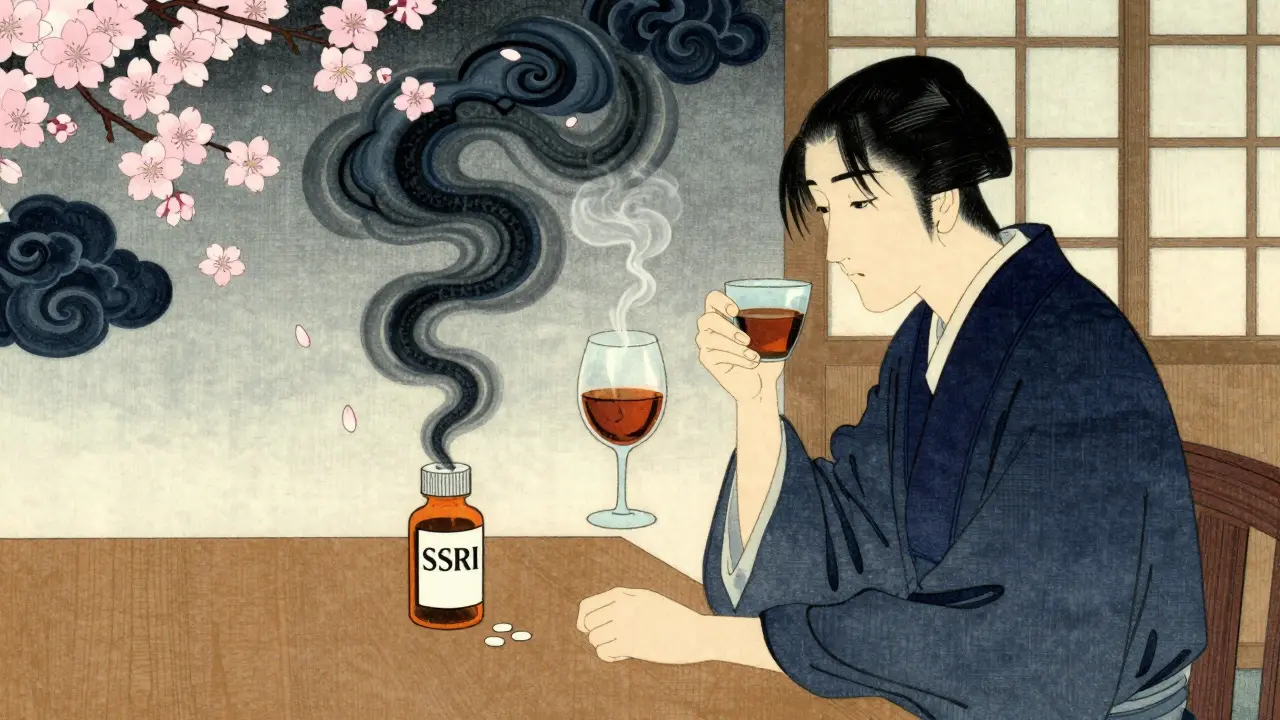
Antidepressant & Alcohol Interaction Checker
Select your antidepressant type to see specific interaction risks.
Combining antidepressants and alcohol isn’t just a bad idea-it’s a medical red flag. For millions of people taking medication for depression or anxiety, drinking alcohol might seem like a harmless way to unwind. But the science says otherwise. Even one drink can turn a routine evening into a medical emergency. This isn’t about being perfect. It’s about survival.
How Alcohol Interferes With Antidepressants
Antidepressants work by adjusting brain chemicals like serotonin, norepinephrine, and dopamine. Alcohol doesn’t just dull your mood-it disrupts the very system these drugs are trying to fix. When you drink, your liver prioritizes breaking down alcohol over processing medication. That means your antidepressant either builds up to dangerous levels or gets flushed out too quickly. Either way, it stops working the way it should.Studies show that even one standard drink per day cuts antidepressant effectiveness by 35-50% in 78% of users. That’s not a small drop. It means your treatment could be failing without you realizing it. And if your depression isn’t improving, your risk of suicidal thoughts goes up. Research from the Journal of Clinical Psychiatry found that people who avoid alcohol while on antidepressants have a 62% higher chance of full recovery. That’s a huge gap.
SSRIs and Alcohol: Getting Drunk Faster, Feeling Worse
SSRIs like Zoloft, Prozac, and Lexapro are among the most commonly prescribed antidepressants. But they react badly with alcohol. Instead of just feeling tipsy, users report getting drunk 30-50% faster. Why? SSRIs interfere with how your liver metabolizes alcohol. One beer can feel like three. Dizziness, nausea, and extreme drowsiness kick in sooner and hit harder.Over 40% of SSRI users who drink report worse depression symptoms within 24 hours. One Reddit user described how a single beer left them dizzy and sick for 12 hours. That’s not a bad night out-that’s a sign your brain is being thrown off balance. And because SSRIs increase serotonin, alcohol can push levels too high, triggering serotonin syndrome: confusion, rapid heartbeat, muscle rigidity, and in severe cases, seizures or death.
Wellbutrin: The Hidden Risk of Psychosis
Wellbutrin (bupropion) is often chosen because it doesn’t cause sexual side effects or weight gain. But it’s one of the most dangerous antidepressants to mix with alcohol. Unlike SSRIs, Wellbutrin affects dopamine. Alcohol floods your system with more dopamine. Together, they can trigger a surge that mimics psychosis.Clinical data from FHE Health shows that 12% of patients who combine Wellbutrin and alcohol experience hallucinations, delusions, or intense paranoia. One patient on PatientsLikeMe described hearing voices telling them to harm themselves after just two glasses of wine. They ended up in the ER for 24 hours. These aren’t rare cases. They’re documented, repeatable outcomes. If you’re on Wellbutrin, there’s no safe amount of alcohol. Even a single drink can push you over the edge.
Tricyclics and MAOIs: The Most Deadly Combinations
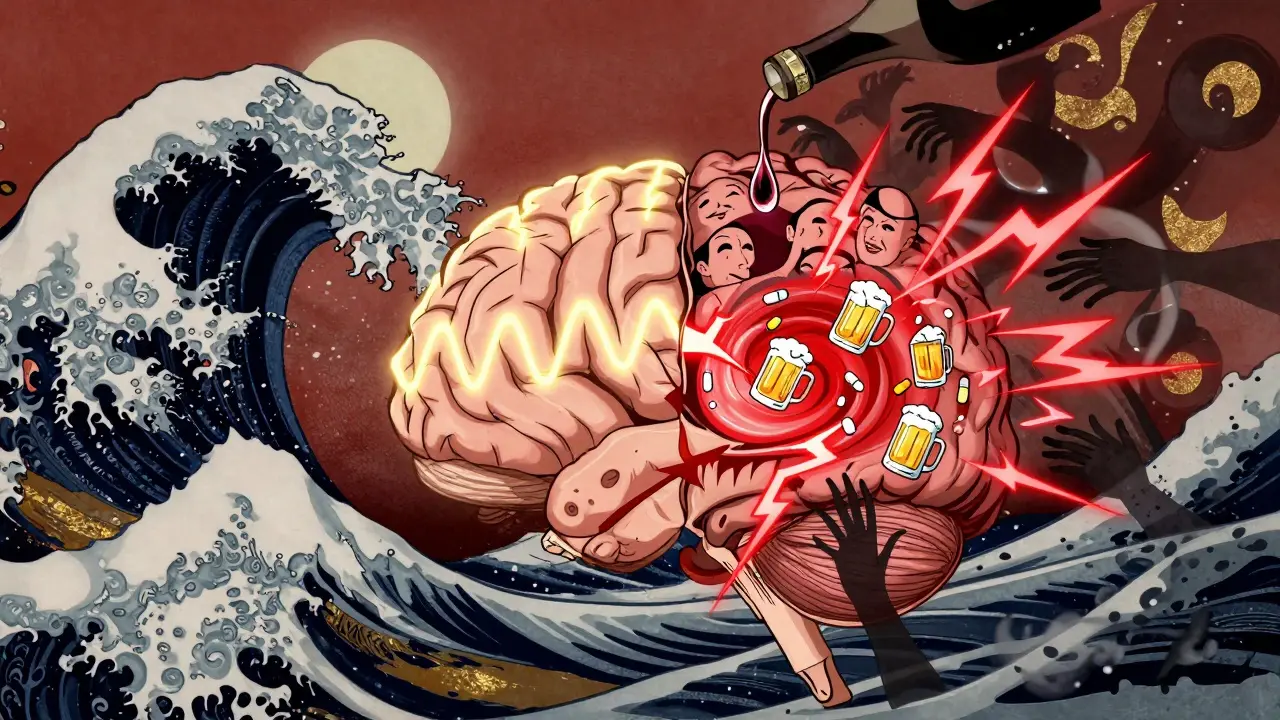
Tricyclic antidepressants (TCAs) like amitriptyline are older but still used. They amplify alcohol’s sedative effects. At a blood alcohol level as low as 0.05%-the legal limit in many places-TCAs can cause breathing to slow dangerously. Falls, car crashes, and accidental overdoses spike dramatically. Studies show TCAs combined with alcohol increase accident risk by over 3 times.MAOIs like Nardil and Parnate are the most dangerous. They prevent the breakdown of tyramine, a chemical found in beer, wine, and aged cheeses. When alcohol is added, tyramine surges, causing blood pressure to spike above 220/120 mmHg. That’s a hypertensive crisis. It can cause a stroke within minutes. The American Addiction Centers reports cases of fatal strokes after just 5 ounces of wine. MAOIs are rarely prescribed today-but if you’re on one, alcohol is an absolute no-go.
Why Even One Drink Can Break Your Treatment
Many people think, “I only have one glass of wine.” But the idea of “moderate drinking” doesn’t apply here. For someone on antidepressants, one drink isn’t moderate-it’s a chemical grenade. The National Institute on Alcohol Abuse and Alcoholism (NIAAA) updated its guidelines in 2023 to say: no safe threshold exists for antidepressant users.Why? Because alcohol doesn’t just affect your mood. It affects your judgment. If you’re depressed, alcohol makes you more impulsive. A 2022 study from Columbia University found that even low alcohol use increased impulsivity by 27% in people on antidepressants. That means more risky decisions, more self-harm, more suicide attempts. In fact, research shows the suicide risk jumps 2.7 times when alcohol is involved.
And it’s not just about the immediate effects. Long-term, alcohol use reduces medication adherence. People who drink while on antidepressants are 32% more likely to skip doses. That’s not laziness. It’s the brain chemistry being rewired by alcohol to crave more of it. You start needing alcohol to feel “normal,” and the antidepressant becomes secondary.
What Experts Really Say
There’s no single answer, but the consensus is clear. Dr. David Baron of FHE Health says mixing Wellbutrin and alcohol can lead to psychosis requiring hospitalization. Dr. Mark Gold of American Addiction Centers warns it worsens depression and raises suicide risk. Dr. Sarah Johnson’s 2022 study confirmed that even small amounts reduce treatment success.There’s one exception some doctors mention: stable patients on SSRIs for over a year with no history of alcohol misuse. Dr. Michael Thase allows occasional, minimal drinking-like one 5-ounce glass of wine once a week-but only under strict monitoring. That’s not a green light. It’s a cautious, rare exception. For most people, especially in the first 8-12 weeks of treatment, the rule is simple: zero alcohol.

Real People, Real Consequences
Patient forums are full of stories that don’t make headlines. A woman on Healthline wrote: “I had one beer with my Lexapro. Within an hour, I couldn’t stand up. My heart raced. I thought I was having a heart attack.” Another said: “After two drinks on Zoloft, I cried uncontrollably for six hours. I felt worse than before I started the medication.”A 2022 survey by the Depression and Bipolar Support Alliance of over 4,300 people found that 67% felt their depression worsen within 48 hours of drinking. 29% said their anxiety spiked. 42% couldn’t work the next day. These aren’t anecdotes. They’re patterns. And they’re preventable.
What You Can Do
If you’re on antidepressants and drink, here’s what to do:- Stop immediately if you’re in the first 8 weeks-your body is still adjusting. Alcohol during this time is a recipe for failure.
- Never drink if you’re on Wellbutrin, MAOIs, or TCAs. The risks are too high.
- If you’re on an SSRI and stable for over a year, talk to your doctor. Even then, limit it to one drink once a week, with food, and never on an empty stomach.
- Track your mood. If you notice increased sadness, anxiety, or fatigue after drinking, stop. It’s not just coincidence.
- Ask about CBT. Cognitive behavioral therapy for alcohol use has a 47% success rate in helping antidepressant users cut back, according to a 2021 JAMA Psychiatry study.
There’s no shame in choosing your health over a drink. Recovery isn’t about perfection. It’s about making choices that keep you alive.
New Tools and Research
In 2023, the FDA approved the first genetic test-GeneSight Psychotropic-that checks your liver enzymes to see how you process alcohol and antidepressants. Some people have a gene variant (ADH1B*2) that makes them 2.3 times more sensitive to alcohol’s effects when on SSRIs. This isn’t science fiction. It’s real, and it’s available.The National Institute of Mental Health is now funding a five-year study to see if tiny amounts of alcohol (once a week) are safe for some people on SSRIs. But until that’s proven, the safest choice is still no alcohol.
Can I have one drink while on antidepressants?
For most people, the answer is no. Even one drink can reduce antidepressant effectiveness, worsen depression, and increase the risk of side effects like dizziness, nausea, and impaired coordination. If you’re on Wellbutrin, MAOIs, or TCAs, one drink can be life-threatening. For people on SSRIs who’ve been stable for over a year, some doctors may allow one drink once a week-but only after a careful discussion with your provider. Never assume it’s safe without medical approval.
Does alcohol make depression worse?
Yes. Alcohol is a depressant. It lowers serotonin and dopamine levels, which are already low in depression. Even a small amount can undo weeks of progress. Studies show 67% of antidepressant users report worse depression symptoms within 48 hours of drinking. Over time, alcohol makes your brain rely on it to feel normal, which deepens the cycle of depression and dependence.
What happens if I drink alcohol with Wellbutrin?
Drinking alcohol with Wellbutrin can trigger a sudden surge in dopamine, leading to hallucinations, delusions, paranoia, or suicidal thoughts. In 12% of documented cases, this leads to emergency hospitalization. These aren’t rare reactions-they’re predictable. If you’re on Wellbutrin, alcohol is not a safe choice. Even one drink can be enough to trigger a psychotic episode.
How long should I wait after stopping antidepressants before drinking?
Wait at least 1-2 weeks after stopping antidepressants before drinking, especially if you were on an SSRI or MAOI. Some medications stay in your system for days or weeks. Abruptly switching from medication to alcohol can cause withdrawal symptoms or rebound depression. Always consult your doctor before reintroducing alcohol, even after stopping treatment.
Are there any antidepressants that are safer with alcohol?
No antidepressant is truly safe with alcohol. While SSRIs carry the lowest risk compared to MAOIs or Wellbutrin, they still interfere with alcohol metabolism and worsen depression symptoms. The idea that SSRIs are “safe in moderation” is outdated and risky. Even one drink can reduce treatment effectiveness by over 35%. The safest approach is complete abstinence while taking any antidepressant.
If you’re struggling with both depression and alcohol use, you’re not alone. Help is available. Talk to your doctor. Seek out support groups. Your mental health isn’t a luxury-it’s your foundation. Protect it.
Eimear Gilroy
February 28, 2026 AT 23:26Been on Lexapro for 3 years. Had one glass of wine last Friday. Woke up at 3 AM heart pounding like I’d run a marathon. Didn’t sleep for hours. Thought I was dying. Never again.
Turns out my liver’s just not built for this combo. Science isn’t lying.
Just… don’t risk it.
Ajay Krishna
March 1, 2026 AT 18:59Hey, I get it. You wanna unwind. I used to drink two beers after work every night. Then I started on sertraline. One drink and I’d feel like I was underwater. Like my brain forgot how to breathe.
It’s not about willpower. It’s chemistry. Your brain’s already fighting to stay steady. Alcohol? It’s like throwing sand in the gears.
I quit. Didn’t miss it. Found hiking. Music. Quiet mornings. Turns out, peace doesn’t need a glass.
Sneha Mahapatra
March 2, 2026 AT 00:55There’s something quiet about healing that doesn’t need noise.
I used to think alcohol was my friend. It wasn’t. It was a ghost that whispered lies: ‘You’re not enough without me.’
Now I sit with my tea. I breathe. I feel the sadness. I don’t numb it.
It’s harder. But it’s mine.
And that’s worth more than any buzz.
Full Scale Webmaster
March 2, 2026 AT 22:30Let’s be real - this whole post is fearmongering dressed up as science. You know who else said ‘one drink can kill you’? The temperance movement. The church. The government. Always the same playbook.
They banned alcohol. Then they banned nicotine. Then they banned sugar. Now it’s SSRIs? Come on.
My cousin drank wine with his Zoloft for 7 years. He’s fine. Healthy. Happy. Had kids. Got promoted. Maybe your brain’s fragile. Mine isn’t.
Stop scaring people. Not everyone’s a ticking time bomb.
Also - GeneSight Psychotropic? That’s a $$$ scam. Pharma’s selling genetic tests to keep you dependent. Wake up.
And if you’re scared of one drink… maybe you need to ask why you’re so attached to the meds in the first place.
Noah Cline
March 3, 2026 AT 09:53From a pharmacokinetic standpoint, ethanol is a competitive substrate for CYP2E1 and CYP3A4 isoforms, which are primary hepatic metabolizers of SSRIs and bupropion. Concurrent ingestion induces non-linear inhibition, leading to elevated plasma concentrations and prolonged half-life.
Additionally, ethanol potentiates GABAergic inhibition while simultaneously suppressing glutamatergic excitation - a dual neurochemical destabilization that directly antagonizes the monoaminergic stabilization SSRIs aim to achieve.
Furthermore, the 35–50% reduction in efficacy isn’t anecdotal - it’s replicated across RCTs with effect sizes >0.8. The NIAAA’s 2023 update was evidence-based, not alarmist.
There is no pharmacologically safe threshold. Period.
Lisa Fremder
March 3, 2026 AT 22:26They’re taking your freedom one pill at a time. Wake up.
Brandie Bradshaw
March 5, 2026 AT 09:01I’ve read every study. Every journal. Every meta-analysis. And here’s what I’ve learned: alcohol doesn’t just interfere with antidepressants - it rewrites your neurobiology.
It’s not about ‘one drink.’ It’s about the neural pathway your brain starts building: ‘I need this to feel okay.’
That’s addiction. And it doesn’t care if you’re ‘just social drinking.’ Your brain doesn’t distinguish between a glass at dinner and a bottle at midnight.
And if you think you’re ‘in control’? You’re already in the grip.
I’ve seen it. In myself. In friends. In patients.
The data isn’t scary. It’s compassionate. It’s saying: ‘You’re worth more than this.’
bill cook
March 6, 2026 AT 01:48I’m on Wellbutrin. Had two sips of beer at a party. Felt like I was watching myself from outside my body. Heard my name in the hallway. No one was there.
Went to ER. Doctor said, ‘You’re lucky you didn’t have a seizure.’
Now I don’t even smell alcohol.
Don’t wait until it’s too late.
Just say no.
Byron Duvall
March 6, 2026 AT 19:21Who’s funding this article? Big Pharma? The rehab industry? The FDA? They make billions off people being scared.
My uncle was on Prozac. Drank one beer. Got dizzy. Went to sleep. Woke up fine.
They say ‘67% feel worse’ - but how many of those people were already spiraling? Correlation isn’t causation.
And that GeneSight test? It’s a gimmick. They want you to buy it. Then pay for therapy. Then pay for more meds.
They’re selling fear like it’s a subscription.
Question everything.
Jimmy Quilty
March 7, 2026 AT 13:30So you’re telling me I can’t have a pint after work? After 12 hours of coding? After my dog died? After my boss screamed at me?
What’s left? A pill and a yoga mat?
And who decided this? Some guy in a lab coat who’s never had a real bad day?
They took our booze, our weed, our coffee, our sugar… now they want our last comfort?
What’s next? Banning hugs?
And don’t even get me started on that ‘GeneSight’ nonsense - that’s just another way for insurers to deny coverage.
It’s control. Not care.
Gigi Valdez
March 9, 2026 AT 11:24Thank you for this comprehensive, evidence-based overview. The clinical data is unequivocal, and the ethical imperative to prioritize patient safety cannot be overstated.
As a clinician, I’ve seen the consequences of underestimating this interaction. The morbidity and mortality rates are preventable, yet persist due to misinformation and stigma.
Public health messaging must remain firm: abstinence is the only safe recommendation for all classes of antidepressants.
Compassion does not mean compromise on safety.
Let us continue to educate - not entertain doubt.
Justin Ransburg
March 10, 2026 AT 12:50I was skeptical too. Thought I could handle one glass.
Then I realized - I wasn’t drinking to relax. I was drinking to escape.
So I stopped. Not because I was told to. But because I finally saw it: the alcohol wasn’t helping me feel better. It was keeping me stuck.
Now I walk. I write. I talk to my therapist.
And yeah - some days are still hard.
But I’m here. Fully. Not half-dead, not half-drunk.
You can do this too. One day at a time.
Brandon Vasquez
March 10, 2026 AT 21:51Just wanted to say - if you’re reading this and thinking ‘I can’t quit,’ you’re not alone.
It’s okay to ask for help.
It’s okay to be scared.
It’s okay to need time.
You don’t have to be perfect. You just have to be willing to try.
I’m here for you. Not to judge. Just to remind you - you’re worth the effort.
One step. One day. One breath.
You’ve got this.