Autoimmune Overlap: Understanding PBC, PSC, and AIH Combined Features
When your liver starts acting strange - fatigue that won’t go away, itching, abnormal blood tests - doctors usually look for one clear cause. But sometimes, it’s not that simple. A growing number of patients are being diagnosed with autoimmune overlap syndromes, where features of more than one autoimmune liver disease show up at once. The most common mix involves Primary Biliary Cholangitis (PBC), Primary Sclerosing Cholangitis (PSC), and Autoimmune Hepatitis (AIH). These aren’t just rare oddities. They’re real, measurable, and often misunderstood.
What Exactly Is an Autoimmune Overlap Syndrome?
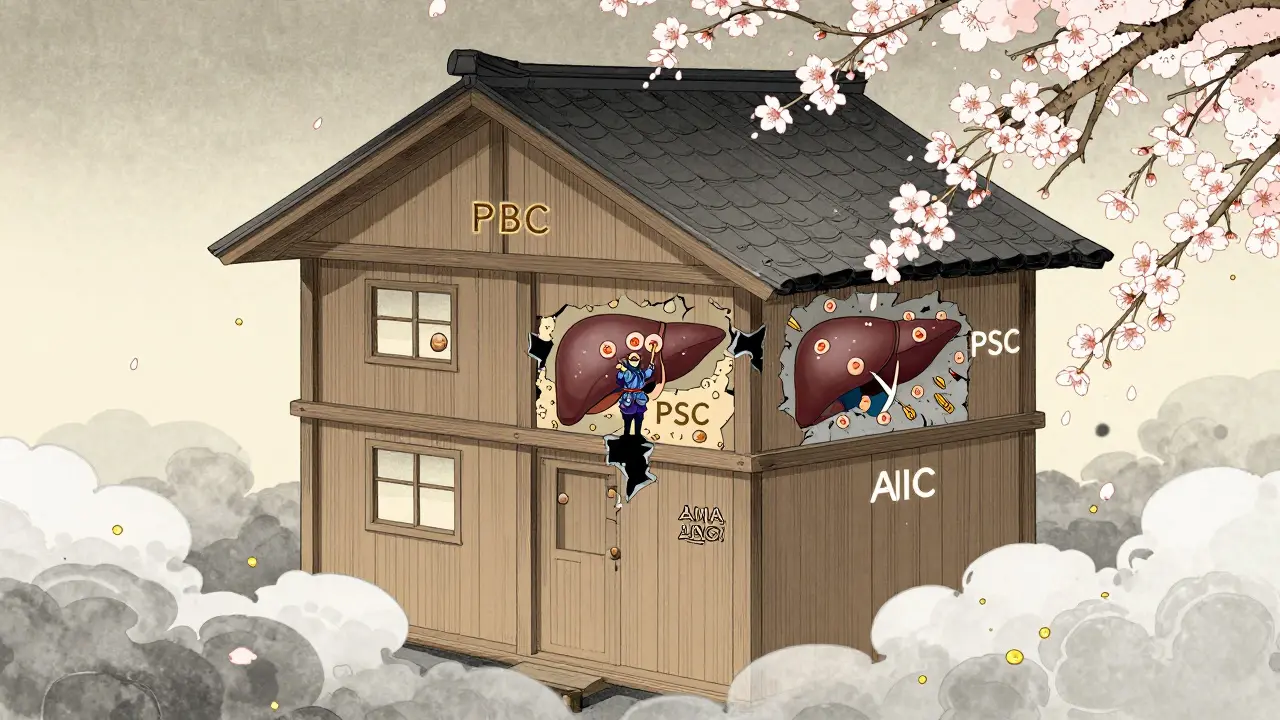
Think of your liver as a house. PBC, PSC, and AIH each damage different parts. PBC attacks the small bile ducts inside the liver. PSC targets the larger bile ducts both inside and outside the liver. AIH goes after the liver cells themselves. When two or more of these attacks happen together, it’s called an overlap syndrome. The most well-documented and common overlap is AIH-PBC. Studies show it occurs in 1% to 3% of people with PBC, and up to 7% of those with AIH. Some studies even report numbers as high as 19%. That’s not negligible. PSC-AIH overlaps are rarer but still documented. PBC-PSC overlap, however, remains controversial. Experts agree: there’s no solid evidence that these two diseases truly coexist as a distinct syndrome. Most cases labeled as such are likely misdiagnosed or represent a single disease with unusual features.How Do You Tell Them Apart?
Each disease has its fingerprint in blood tests and liver tissue.- AIH shows up as high ALT and AST - the enzymes that signal liver cell damage. It’s also linked to high IgG levels and autoantibodies like ANA (antinuclear antibodies) and SMA (smooth muscle antibodies).
- PBC is marked by high ALP and γ-GT - signs of bile duct blockage. Over 90% of PBC patients have AMA (anti-mitochondrial antibodies). In rare cases, when AMA is negative, antibodies against sp100 or gp210 proteins can help confirm the diagnosis.
- PSC also raises ALP and γ-GT, but unlike PBC, it rarely shows AMA. Instead, it often appears as strictures (narrowing) in the bile ducts on imaging like MRCP.
The problem? In overlap syndromes, these markers blur. A patient might have high ALP (like PBC) AND high ALT (like AIH). They might test positive for AMA AND ANA. This is where diagnosis gets tricky. Many doctors miss it because they’re trained to look for one disease, not two.
Diagnosing the Overlap: It’s Not a Checklist
There’s no official diagnostic criteria that everyone agrees on. But most experts use a practical approach: if a patient meets two out of three key features for both diseases, it’s likely an overlap. For example, to suspect AIH-PBC overlap:- ALP is elevated (PBC feature)
- AMA is positive (PBC feature)
- ALT is elevated (AIH feature)
- IgG is high (AIH feature)
- Liver biopsy shows interface hepatitis (AIH) + bile duct damage (PBC)
If four or five of these are present, it’s almost certainly an overlap. Biopsy isn’t always required for PBC, but in suspected overlap cases, it’s essential. Without it, you’re guessing.
Studies show that up to 20% of patients in community clinics are misdiagnosed. One patient might be labeled as PBC and treated with UDCA - but if they also have AIH, that alone won’t stop the inflammation. Their liver keeps getting damaged.

Why Does This Matter for Treatment?
Treatment changes everything.- PBC is treated with ursodeoxycholic acid (UDCA). It helps bile flow and slows disease.
- AIH is treated with steroids (like prednisone) and azathioprine. These calm the immune system.
But if you have AIH-PBC overlap? UDCA alone often fails. About 30% to 40% of these patients don’t respond well to UDCA alone. They need steroids too. Missing this means your liver keeps getting hit from both sides.
There’s no standard protocol, but most hepatologists start with UDCA and add immunosuppressants if liver enzymes stay high or if biopsy shows active inflammation. The goal isn’t just to normalize numbers - it’s to prevent cirrhosis. Untreated overlap syndromes can lead to cirrhosis in 30% to 40% of patients within 10 years. That’s the same risk as having one disease alone.
What About PSC and Overlap?
PSC is the odd one out. It’s harder to treat. There’s no proven medication like UDCA for PSC. It’s often linked to inflammatory bowel disease, especially ulcerative colitis. PSC-AIH overlap is real, but rare. These patients usually have high IgG, positive ANA, and bile duct strictures. Treatment is similar to AIH-PBC: UDCA may help with bile flow, but immunosuppressants are needed to control the liver inflammation.And PBC-PSC? There’s no convincing evidence it exists. Most reported cases are either misdiagnosed PSC or PBC with unusual bile duct changes. Don’t assume it’s a third type of overlap - it’s likely a mislabel.
What Symptoms Should You Watch For?
The classic signs of liver disease show up here too:- Extreme fatigue
- Itchy skin (especially at night)
- Dark urine, pale stools
- Jaundice (yellowing of skin or eyes)
- Joint pain or muscle aches
- Unexplained weight loss
But here’s the catch: many people with overlap syndromes have no symptoms at all. They’re found by accident during routine blood work. That’s why regular monitoring matters. A single normal ALT doesn’t mean your liver is safe.

What’s the Long-Term Outlook?
The good news? If caught early and treated properly, many patients with overlap syndromes do well. Liver transplants are still the last resort, just like with single diseases. But outcomes after transplant are similar - not worse. The big risk is delay. If you’re diagnosed with PBC and only get UDCA, but you also have hidden AIH, the inflammation keeps burning. Over time, that leads to scarring, cirrhosis, and even liver cancer. That’s why follow-up is lifelong. Blood tests every 3 to 6 months. Liver scans when needed. Biopsy if things don’t add up.What’s Next in Research?
Experts are working on better definitions. The International Autoimmune Hepatitis Group and the European Association for the Study of the Liver are running new studies to validate diagnostic criteria. They’re also looking at new autoantibodies and genetic markers that might predict overlap risk. One thing’s clear: autoimmune liver diseases aren’t separate boxes. They’re a spectrum. Some people sit firmly in one category. Others drift between them. Overlap syndromes aren’t a glitch - they’re a signal that our old categories might be too rigid.For patients, the message is simple: if your liver disease doesn’t fit neatly, speak up. Ask for a second opinion. Push for a full workup - AMA, ANA, IgG, biopsy. Don’t let a single test define your treatment. Your liver is worth the extra effort.
Can you have PBC and PSC at the same time?
There’s no solid evidence that PBC and PSC truly overlap as a distinct syndrome. While isolated case reports exist, experts agree these are likely misdiagnoses or unusual presentations of one disease. PBC affects small bile ducts inside the liver, while PSC affects larger ducts inside and outside. Their patterns don’t typically combine. If someone has features of both, doctors usually look for another explanation.
Is AIH-PBC overlap rare?
It’s not rare - it’s underdiagnosed. Studies show 1% to 3% of PBC patients and up to 7% of AIH patients have overlap features. Some reports suggest as high as 19%. Because symptoms are often mild and blood tests can be confusing, many cases are missed, especially outside specialist centers.
Do you need a liver biopsy to diagnose overlap?
Not always for PBC alone - but yes for overlap. If you have signs of both PBC and AIH (like high ALP and high ALT), a biopsy is critical. It’s the only way to see if there’s interface hepatitis (from AIH) along with bile duct damage (from PBC). Blood tests can mislead. Biopsy gives the real picture.
Can UDCA alone treat AIH-PBC overlap?
Usually not. About 30% to 40% of patients with AIH-PBC overlap don’t respond well to UDCA alone because the immune attack on liver cells (AIH) keeps going. These patients need immunosuppressants like prednisone or azathioprine in addition to UDCA. Treating just the bile ducts isn’t enough - you have to calm the immune system too.
Can autoimmune overlap lead to liver cancer?
Yes - but only if it’s left untreated. Untreated overlap syndromes can lead to cirrhosis in 30% to 40% of cases within 10 years. Once cirrhosis develops, the risk of hepatocellular carcinoma (liver cancer) increases. Early diagnosis and proper treatment - combining UDCA and immunosuppressants - significantly lower this risk.
Janelle Pearl
March 8, 2026 AT 15:17I’ve seen so many patients come in with "just PBC" and leave confused when UDCA doesn’t help. It’s heartbreaking. One woman I worked with had fatigue so bad she couldn’t hold her grandkids. Her ALT was normal, but her ALP was sky-high. We didn’t biopsy at first - big mistake. Turns out, she had AMA AND ANA. The biopsy showed interface hepatitis. Once we added azathioprine, she started sleeping through the night. It’s not magic. It’s just not being lazy with diagnostics.
Neeti Rustagi
March 9, 2026 AT 11:31While I appreciate the clinical depth of this post, I must emphasize that the diagnostic ambiguity surrounding overlap syndromes remains a significant challenge in global healthcare settings. In India, where access to advanced imaging and liver biopsy is limited, misclassification is not merely a statistical concern-it is a matter of life-altering therapeutic delay. The reliance on serological markers without histological confirmation is, frankly, a dangerous norm in resource-constrained environments.
Furthermore, the assertion that PBC-PSC overlap is a mislabeling requires further validation through multicenter studies from non-Western populations. Genetic and environmental factors may manifest differently in South Asian cohorts, potentially yielding distinct phenotypes. Until such data is published, we risk perpetuating diagnostic colonialism.
Practitioners must be trained to recognize that elevated ALP alone does not equate to PBC. It is imperative that guidelines be adapted to reflect global heterogeneity-not just Western paradigms.
Dan Mayer
March 11, 2026 AT 07:09lol so u mean if u have itchy skin and high alp u gotta get a biopsy?? like duh. i thought this was a medical journal not a soap opera. everyone knows u need to check ama and anas. why is this even a thing?? my cousin had this and she just took some pills and it was fine. why do doctors make everything so complicated??
Samantha Fierro
March 11, 2026 AT 23:07This is one of the most important pieces I’ve read all year. I work in hepatology outreach, and every time I see a patient diagnosed with "PBC" who isn’t responding to UDCA, I ask: "Have you ever been tested for ANA or IgG?" More often than not, the answer is no. We’re missing overlaps because we’re taught to compartmentalize, not connect. Biopsy isn’t invasive-it’s essential. And yes, the 30-40% non-response rate to UDCA alone? That’s not a fluke. That’s a red flag. We need to train residents to think in spectra, not silos.
To the clinicians reading this: don’t wait for perfect numbers. Wait for the patient who still itches, still tires, still has abnormal labs. That’s your overlap. Treat it.
Ray Foret Jr.
March 12, 2026 AT 16:29Man I wish I knew this 5 years ago 😅 I was diagnosed with PBC and put on UDCA. Felt okay for a while… then started getting joint pain and weird fatigue. My doc said "it’s just PBC getting worse." But I pushed. Got ANA tested. Positive. Then IgG. Way up. Biopsy confirmed interface hepatitis. Added prednisone. Changed my life. Seriously. I can now play with my kids without needing a nap. Don’t let anyone tell you it’s "just one disease." Your liver doesn’t care about your doctor’s comfort zone.
PS: I’m still on UDCA + azathioprine. No regrets. 💪
Peter Kovac
March 13, 2026 AT 07:30The data presented here is methodologically unsound. The cited prevalence rates (up to 19%) are drawn from tertiary referral centers, introducing significant selection bias. Community-based studies show rates below 0.5%. The notion that biopsy is "essential" is an overreach. Many patients with borderline serology are subjected to unnecessary invasive procedures. Furthermore, the conflation of statistical correlation with causal overlap undermines evidence-based practice. This article risks promoting diagnostic inflation.
One must ask: is this a true syndrome-or merely an artifact of increased antibody testing and declining biopsy thresholds?
Leon Hallal
March 13, 2026 AT 20:49I've been reading this for 20 minutes and I'm still not sure if I have this or not. My liver feels weird. I'm tired. I itch. I had a blood test last year. ALP was high. They said "maybe PBC" and gave me UDCA. I took it for 3 months. Nothing changed. Now I'm scared. I don't even know who to ask. Everyone says "go to a specialist" but specialists are $800. I can't afford that. What do I do?
APRIL HARRINGTON
March 15, 2026 AT 05:28OMG I JUST REALIZED I MIGHT HAVE THIS 😭 I had PBC diagnosed 2 years ago. Took UDCA. Still itchy. Still tired. My ANA was positive but they said "oh that’s just a fluke". I cried last night. I looked up "overlap syndrome" and everything clicked. I’m going to demand a biopsy next week. I’m not letting them ignore this anymore. If you’re reading this and you’re still tired after treatment… YOU NEED TO SPEAK UP. I’m doing it. You can too.
Scott Easterling
March 17, 2026 AT 05:15So… let me get this straight… the liver has a "team" of autoimmune diseases that "team up"?? Like, are we saying the immune system is just… having a party?? And the doctors are the bouncers who don’t know who’s invited?? This sounds like a conspiracy. I bet Big Pharma is pushing biopsy because they make money off it. And the "overlap" thing? Totally made up to sell more drugs. UDCA is fine. Just take it. Stop overcomplicating.
Melba Miller
March 18, 2026 AT 03:26As an American woman who has fought for healthcare access for 12 years, I will not sit quietly while Western medicine ignores the truth. This "overlap" is a distraction. Real autoimmune disease is caused by toxins in vaccines, glyphosate in our food, and government surveillance through water fluoridation. They want you to believe it’s "genetic" so you’ll take drugs and stop asking questions. Biopsy? That’s how they insert tracking chips. Don’t trust the system. Go organic. Drink apple cider vinegar. Sleep on copper sheets. Your liver will thank you.
Nicholas Gama
March 19, 2026 AT 20:01The notion that "overlap syndromes" are clinically meaningful is a symptom of medical reductionism. The term itself is semantically incoherent-autoimmune diseases are defined by their target, not their coexistence. If a patient exhibits features of multiple conditions, it is either a misdiagnosis or a single disease with pleiotropic expression. The push for biopsy and combination therapy is not evidence-based-it is institutional inertia disguised as innovation.
Furthermore, the emphasis on AMA and ANA ignores the fact that autoantibodies are epiphenomena. They correlate, they do not cause. This article is not helpful. It is performative.
Mary Beth Brook
March 21, 2026 AT 03:50From a hepatology research standpoint, the term "overlap syndrome" lacks operational definition. The diagnostic criteria are heterogenous across institutions. The 2019 AASLD guidelines explicitly state that diagnostic overlap should not be applied without histologic confirmation. The referenced prevalence figures are not population-based. The clinical utility of combination therapy remains unproven in randomized trials. This post is dangerously oversimplified. We need biomarkers-not anecdotes.
rafeq khlo
March 22, 2026 AT 16:43It is evident that the current paradigm of autoimmune liver disease classification is fundamentally flawed. The reliance on serological markers such as AMA and ANA without validation through proteomic or genomic profiling is a grave error. The human immune system does not operate in binary categories. The concept of overlap is not an anomaly-it is the rule. Yet, the medical establishment clings to outdated frameworks for administrative convenience. Biopsy is not a luxury-it is the only honest diagnostic tool. The failure to standardize diagnostic thresholds across global populations is not negligence-it is systemic abandonment of patients in non-Western contexts.
For those suffering in silence: demand genomic sequencing. Demand access to international registries. Your liver is not a puzzle to be solved with two checkboxes. It is a battlefield-and you are the general.
Katy Shamitz
March 24, 2026 AT 10:07Ugh I’m so tired of people acting like this is some new breakthrough. My sister had this for YEARS before anyone figured it out. She went to 5 doctors. One said "it’s stress." One said "you’re just fat." One said "you’re imagining it." Finally, a nurse practitioner in Ohio looked at her labs and said "this isn’t PBC alone." She got the biopsy. Got steroids. Now she’s fine. But it took 4 years. 4 YEARS. And no one warned her. No one told her to ask. So if you’re reading this and you’re still tired… don’t wait. Don’t be polite. Demand the biopsy. Demand the ANA. Demand the IgG. You’re not being dramatic. You’re being smart.
Robert Bliss
March 25, 2026 AT 14:07Just wanted to say thanks for writing this. I’ve been living with AIH-PBC for 7 years. I thought I was alone. I didn’t know others had this. I’ve been on UDCA + azathioprine since 2018. My numbers are stable. I hike now. I sleep. I’m not cured-but I’m not dying either. If you’re scared, I get it. But please, don’t give up. Ask for help. Ask again. And if your doctor shrugs? Find a new one. You deserve more than a shrug.
Ray Foret Jr.
March 25, 2026 AT 22:54Also-just wanted to reply to the guy who said "why biopsy?" 😅 I get it. I thought the same. But imagine your liver is a house. UDCA fixes the pipes. But if someone’s burning the walls? You need fire extinguishers too. Biopsy tells you if the walls are on fire. No way around it. I cried when I saw the report. But I was so relieved. Finally… someone saw me.