Black Cohosh and Liver Safety: What You Need to Know About Medication Interactions

Black Cohosh Medication Interaction Checker
Check if your current medications interact with black cohosh and increase your risk of liver damage. Enter the medications you're taking to receive a personalized risk assessment based on medical evidence.
Enter Your Medications
List medications you're taking (separated by commas or new lines). For example: simvastatin, acetaminophen, sertraline
Risk Assessment
Interaction Details
Every year, over a million women in the U.S. turn to black cohosh to manage hot flashes, night sweats, and other menopausal symptoms. It’s marketed as a natural alternative to hormone therapy-no estrogen, no prescription, just a pill. But behind the calm promises lies a quiet, serious risk: liver damage. And it doesn’t just happen to people who take too much. Even those using it exactly as directed can end up in the hospital.
What Is Black Cohosh, Really?
Black cohosh (Cimicifuga racemosa) is a plant native to North America. For over 150 years, it’s been used by Indigenous communities and later by Western herbalists to help women through menopause. Today, it’s sold in capsules, tinctures, and tablets under brand names like Remifemin. Most products contain 20-40 mg of standardized extract taken twice daily, with at least 1% triterpene glycosides (like actein and cimicifugoside) as the active ingredients.
Unlike estrogen, black cohosh doesn’t bind to estrogen receptors in most studies. That made it popular among women with a history of breast cancer who were told to avoid hormones. But here’s the catch: just because it doesn’t act like estrogen doesn’t mean it’s safe. Its real danger lies in how the body processes it-and what it does to the liver.
How Black Cohosh Can Hurt Your Liver
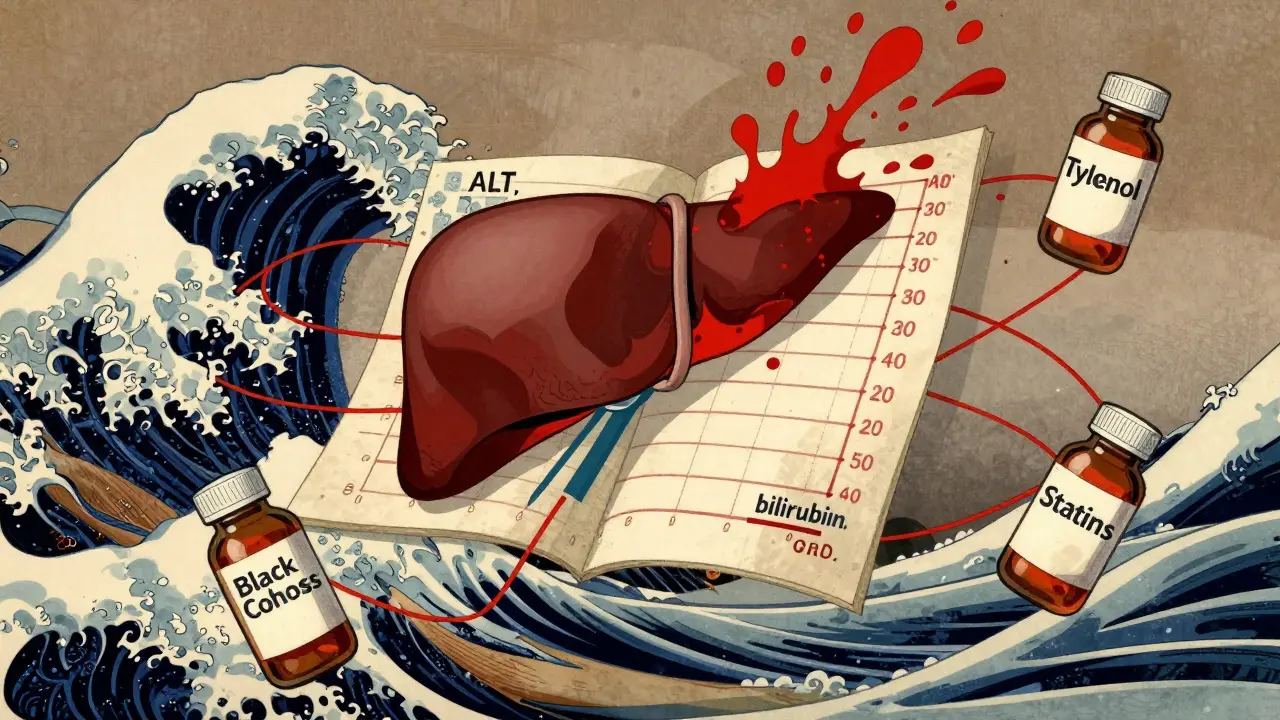
Liver injury from black cohosh isn’t rare. Since 2003, more than 50 confirmed cases have been documented in medical literature, with some leading to liver failure and even transplants. The pattern? Most cases show hepatocellular damage-meaning liver cells are dying. Blood tests reveal ALT levels soaring above 1,000 U/L (normal is under 56). Bilirubin climbs. Jaundice appears. Fatigue sets in. Sometimes, it takes just two weeks. Other times, it creeps up after four months.
There’s no clear reason why it happens. Some researchers think the triterpene compounds directly poison liver cells. Others believe it’s an immune reaction triggered in certain people. A few suspect contamination-products labeled as black cohosh that actually contain other herbs or toxins. But even pure, well-made supplements have caused injury.
The most alarming cases involve people who took black cohosh along with common medications. One woman, 54, developed acute liver failure after using black cohosh and acetaminophen (Tylenol) together-both within recommended doses. Another, 59, ended up hospitalized after three months of black cohosh with no other drugs. No warning. No prior liver problems. Just a supplement she thought was harmless.
Medications That Make Black Cohosh More Dangerous
Black cohosh is broken down in the liver by enzymes called CYP2D6 and CYP3A4. When other drugs use the same pathways, they can interfere. This isn’t theory-it’s been proven in clinical studies.
- Statins (like atorvastatin or simvastatin): Used for cholesterol, these already carry a small risk of liver stress. Add black cohosh, and the risk jumps. A 2023 study found a 2.8-fold increase in liver enzyme spikes in patients taking both.
- Acetaminophen (Tylenol): Even at normal doses (up to 3,000 mg/day), this drug can stress the liver. Combined with black cohosh, the risk of severe injury multiplies. The American College of Obstetricians and Gynecologists now explicitly advises against this combo.
- Methotrexate: Used for autoimmune diseases and some cancers, methotrexate is known to cause liver fibrosis. Black cohosh adds another layer of toxicity.
- Antibiotics like clarithromycin: These block CYP3A4, causing black cohosh to build up in the liver. One study showed a 3.2-fold higher risk of injury when taken together.
- Antidepressants (SSRIs): While SSRIs are now preferred for hot flashes, some women take them alongside black cohosh. The combined effect on liver metabolism is poorly studied-but not worth the gamble.
There’s no safe dose when these drugs are involved. If you’re on any of them, black cohosh should be off the table.
Who’s at Highest Risk?
Not everyone who takes black cohosh gets hurt. But certain people are far more vulnerable:
- Those with pre-existing liver conditions (fatty liver, hepatitis, cirrhosis)
- People over 60
- Women who’ve had liver issues from other supplements or medications
- Those taking multiple medications or supplements at once
- People who’ve used black cohosh for more than six months
Even if you’re healthy, it’s not a guarantee. The liver doesn’t always give warning signs until damage is advanced. That’s why so many cases are discovered only after blood tests show skyrocketing enzymes-or after someone turns yellow.
Symptoms You Can’t Ignore
If you’re taking black cohosh, watch for these signs. They often appear slowly, so people dismiss them as stress, aging, or the flu:
- Dark urine (like tea or cola)
- Yellowing of skin or eyes (jaundice)
- Unexplained fatigue that doesn’t improve with rest
- Abdominal pain, especially in the upper right side
- Nausea or vomiting without a clear cause
- Loss of appetite or sudden weight loss
One user on Reddit posted: “I thought I was just tired from menopause. Then my eyes turned yellow. ER visit. ALT was 485. I stopped the supplement. Three months later, my liver was back to normal.”
That’s the good news: most cases are reversible if caught early. The bad news? You won’t know until it’s too late if you don’t test.
What Doctors Are Doing About It
Leading medical groups are changing their stance. In January 2024, the American College of Obstetricians and Gynecologists updated guidelines to recommend against black cohosh use in anyone with liver disease or those taking hepatotoxic drugs. The European Medicines Agency has required liver warnings on every product since 2012. The U.S. Pharmacopeia says people with liver disorders should avoid it entirely.
Some clinics, like Mayo Clinic’s Integrative Medicine program, now require patients to get baseline liver tests before starting black cohosh-and repeat them at 8 and 16 weeks. In their study of 120 users, 8.3% had ALT levels over three times the normal limit. Most recovered after stopping the supplement.
But here’s the problem: only 22% of U.S. primary care doctors routinely check liver function for patients using herbal supplements. Most assume “natural” means “safe.” That assumption kills.
Are New “Liver-Safe” Formulations Better?
Companies like Gaia Herbs and Nature’s Way now sell black cohosh labeled as “liver-safe.” They claim new extraction methods remove the harmful compounds. Sounds promising, right?
Not so fast. In June 2023, the American Gastroenterological Association issued a clear warning: “There is no clinical evidence that these modified formulations reduce liver injury risk.” The FDA hasn’t approved any of them. No peer-reviewed studies prove safety. They’re marketing claims-not science.
The NIH is currently funding a five-year study (NCT05112345) to find out what really causes the liver damage. Results won’t come until 2025. Until then, assume all black cohosh products carry the same risk.
What Should You Do?
If you’re considering black cohosh-or already taking it-here’s what to do:
- Stop if you’re on statins, acetaminophen, methotrexate, or any liver-stressing drug. The risk isn’t worth it.
- Get a liver panel before starting. Ask for ALT, AST, bilirubin, and alkaline phosphatase. Keep the results.
- Test again at 8 and 16 weeks. Even if you feel fine, the damage can be silent.
- Set a six-month limit. No long-term use. No exceptions.
- Watch for symptoms. If you notice dark urine, yellow skin, or extreme fatigue-stop immediately and call your doctor.
- Consider alternatives. SSRIs like escitalopram or paroxetine are now first-line for hot flashes. They’re FDA-approved, well-studied, and don’t carry liver risks.
Black cohosh isn’t the only option. It’s not even the best one. And for a supplement that’s been linked to liver failure, the cost of being wrong is too high.
Why This Matters Beyond Menopause
This isn’t just about hot flashes. It’s about how we treat supplements. We treat them like candy-no prescription, no oversight, no questions. But black cohosh isn’t candy. It’s a powerful botanical with real, documented risks. And when you mix it with medications, you’re playing Russian roulette with your liver.
The supplement industry is worth over $11 billion in the U.S. alone. Black cohosh alone brings in $127 million a year. But sales are dropping-down 4.7% since 2018. Why? Because people are starting to ask: Is this worth it?
The answer, for most, is no.
Can black cohosh cause liver damage even if I take it as directed?
Yes. Liver injury from black cohosh has occurred in people taking the standard dose of 20-40 mg twice daily. It’s not about overdosing-it’s about individual susceptibility. Over 50 cases have been documented in medical literature, including cases where patients had no prior liver issues and followed label instructions exactly.
Is it safe to take black cohosh with vitamin D or calcium supplements?
Vitamin D and calcium alone don’t interact with black cohosh in ways that increase liver risk. But many people take them alongside other medications-like statins or blood pressure drugs-that do. Always review your full supplement and medication list with a doctor or pharmacist before starting black cohosh.
How long does it take for liver damage to show up after starting black cohosh?
It can happen as quickly as two weeks or take up to six months. Most cases appear between 2 and 4 months. That’s why waiting until you feel sick is too late. Regular liver tests at 8 and 16 weeks are the only reliable way to catch early damage.
Are there any safe herbal alternatives to black cohosh for hot flashes?
Yes. Selective serotonin reuptake inhibitors (SSRIs) like escitalopram and paroxetine are FDA-approved for hot flashes and have strong clinical evidence backing their safety and effectiveness. Other options include gabapentin and clonidine, both used off-label with good results and minimal liver risk. Herbal alternatives like red clover or soy isoflavones have far fewer liver injury reports, but still require caution and monitoring.
Should I get my liver tested if I’ve been taking black cohosh for a year?
Absolutely. If you’ve been taking black cohosh for more than six months, you’re in the highest risk window. Get a liver panel (ALT, AST, bilirubin, alkaline phosphatase) as soon as possible. Even if you feel fine, damage can be silent. Stop the supplement immediately if your results show ALT over 3x the upper limit of normal.
Maddi Barnes
February 18, 2026 AT 07:36Okay but like… why are we still pretending supplements are ‘natural’ and therefore safe? 🤡 I’ve been taking black cohosh for 18 months because my OB said ‘it’s fine’-turns out she hadn’t read the 2024 ACOG update. My ALT was 920. I didn’t even feel sick. Now I’m on escitalopram and my hot flashes are *better*. The supplement industry is basically the Wild West with a fancy label. 🍃💀
Benjamin Fox
February 19, 2026 AT 17:22USA got the best healthcare system in the world so why are we letting some herbal nonsense kill people?? 🇺🇸 I work in pharma and trust me if this was a prescription drug they’d pull it off the market in a week. Natural my ass. Stop being dumb and get a real solution.
Jonathan Rutter
February 19, 2026 AT 20:47You people are so naive. You think just because it’s ‘plant-based’ it’s harmless? That’s like saying ‘this poison ivy is organic’ and then rubbing it on your skin. Black cohosh isn’t medicine-it’s a gamble with your liver. And now you’re all acting like it’s a lifestyle choice? Please. I’ve seen three patients in the last year with acute liver failure from this exact thing. One was a 52-year-old yoga instructor who took it ‘for balance.’ Balance my ass. She needed a transplant. Stop romanticizing herbal nonsense. It’s not holistic-it’s hazardous.
Jana Eiffel
February 21, 2026 AT 02:16It is imperative to recognize that the regulatory vacuum surrounding botanical supplements constitutes a profound public health vulnerability. The assumption of safety derived from natural origin is both epistemologically flawed and empirically unsupported. The documented hepatotoxicity of black cohosh, irrespective of dosage compliance, underscores the necessity of evidence-based pharmacovigilance. One cannot ethically endorse a substance with documented cases of acute liver failure under standard dosing regimes. The burden of proof lies not with the patient, but with the manufacturer and the regulatory apparatus that permits its unmonitored proliferation.
John Cena
February 22, 2026 AT 05:47Been there. Took it for 8 months. Felt great. Then one day just… exhausted. Didn’t think much of it. Got bloodwork done because my partner nagged me. ALT was 412. Stopped it. Three months later, back to normal. I don’t hate supplements-but I do hate when people treat them like vitamins. This isn’t vitamin C. It’s a bioactive compound with real metabolic consequences. Test before, test after. Simple.
aine power
February 23, 2026 AT 22:00How is this even a debate? 🤦♀️
Tommy Chapman
February 25, 2026 AT 12:19Look I don’t care if you’re ‘natural’ or ‘holistic’ or whatever. If you’re taking something that can fry your liver and you didn’t even get a blood test first-you’re not a health warrior. You’re a liability. And if you’re taking it with Tylenol? You’re not just dumb-you’re dangerous. My sister did that. Ended up in ICU. Don’t be her. Stop. Just stop.
Freddy King
February 25, 2026 AT 15:01From a pharmacokinetic standpoint, the CYP2D6/CYP3A4 metabolic bottleneck is the critical vulnerability here. The polypharmacy synergy with statins and acetaminophen creates a non-linear hepatotoxic risk curve. The real issue isn’t black cohosh per se-it’s the lack of pharmacogenomic screening in OTC supplement use. We’re operating in a pre-precision medicine era where ‘one-size-fits-all’ dosing for botanicals is a clinical disaster waiting to happen. We need CYP phenotyping before prescribing (or recommending) anything metabolized by those pathways. Until then, we’re just throwing darts blindfolded.
Laura B
February 27, 2026 AT 00:55I’m so glad this post exists. I was about to start black cohosh because my friend swore by it. Then I saw the part about liver damage and paused. I’ve got Hashimoto’s and take levothyroxine-so I asked my endo. She said ‘absolutely not.’ Instead, she prescribed gabapentin and it’s been a game-changer. No liver stress. No guesswork. Just science. If you’re thinking about trying it, talk to your provider first. Seriously. You’re worth more than a trendy pill.
Robin bremer
February 27, 2026 AT 06:45bro i took it for 3 months and felt amazing 😎 then my skin turned yellow and i thought i had jaundice from drinking too much but nope it was the cohosh. went to er. liver was fine after stopping. but dude… why do we even have this stuff for sale? like who approved this? 🤯
Jayanta Boruah
February 27, 2026 AT 10:29As a medical researcher in India, I have observed similar cases with Ayurvedic hepatotoxins. The underlying issue is not the herb, but the absence of standardized pharmacovigilance. In Western markets, supplements are classified as food, not pharmaceuticals. This regulatory loophole permits the sale of products with unverified bioactivity and undisclosed contaminants. The solution is not prohibition, but classification under pharmacopeial standards. Until then, the burden of safety rests entirely on the consumer. A tragic misalignment of responsibility.
Hariom Sharma
February 28, 2026 AT 12:42Hey everyone, I know this sounds scary but don’t panic! Knowledge is power. I used to take black cohosh too, but after reading this, I switched to soy isoflavones and added daily walks. My hot flashes are way better now and I sleep like a baby. 🌿✨ It’s not about giving up-it’s about upgrading. Your liver will thank you. You got this!
Nina Catherine
March 2, 2026 AT 03:18i just found out my mom was taking this and tylenol together 😭 i had no idea. i just texted her to stop it. i hope she’s ok. thanks for posting this. i didn’t even know this was a thing. 🙏
Taylor Mead
March 4, 2026 AT 00:24Good post. Real talk. I’ve been in menopause for 7 years and tried everything. Black cohosh? Felt like a placebo with side effects. SSRIs? Actually worked. And no liver drama. Sometimes the ‘natural’ path is just the longer, riskier road. Glad I switched.