Dry Eye Syndrome: Understanding Tear Deficiency and Choosing the Right Artificial Tears

Your eyes feel gritty, burning, or strangely watery. You blink, but the discomfort doesn’t go away. This isn’t just tiredness from staring at a screen all day. It could be Dry Eye Syndrome, formally known as Dry Eye Disease (DED) or Dysfunctional Tear Syndrome. This condition affects millions of people globally, causing more than just minor irritation-it can lead to chronic inflammation and even vision damage if left untreated.
Most people think dry eye means their eyes simply lack moisture. The reality is much more complex. Your tear film is a sophisticated structure made of three distinct layers: lipid, aqueous, and mucin. When any of these layers fail, your eyes suffer. Understanding whether you have aqueous tear-deficient dry eye (ADDE) or evaporative dry eye (EDE) is the first step toward finding relief that actually lasts.
The Two Main Types of Dry Eye
To treat dry eye effectively, you need to know which type you have. They require different approaches because the root causes are completely different.
Aqueous Tear-Deficient Dry Eye (ADDE) happens when your lacrimal glands don’t produce enough water-based tears. This accounts for about 10-15% of cases. If you have an autoimmune condition like Sjogren's syndrome, you are at higher risk. Sjogren's affects 1 to 4 million Americans, mostly women, and it directly attacks the glands that make tears. Age also plays a huge role; as we get older, our tear production naturally drops. Studies show prevalence jumps from 7.4% in people aged 20-30 to 18.6% in those over 70.
Evaporative Dry Eye (EDE) is far more common, making up roughly 86% of all cases. Here, your glands produce enough water, but the tears evaporate too quickly. This is usually caused by Meibomian Gland Dysfunction (MGD). These tiny glands along your eyelids secrete oil (lipids) that sits on top of your tears to keep them from drying out. When these glands get clogged or inflamed, the oil layer breaks down. Without this protective barrier, your tears vanish within seconds instead of lasting minutes. Environmental factors like wind, low humidity, and prolonged screen time worsen this evaporation.
| Feature | Aqueous Tear-Deficient (ADDE) | Evaporative Dry Eye (EDE) |
|---|---|---|
| Primary Cause | Insufficient water production | Excessive tear evaporation |
| Prevalence | 10-15% of cases | 85-90% of cases |
| Key Risk Factors | Sjogren's syndrome, aging, medications | MGD, blepharitis, screen time, contact lenses |
| Tear Osmolarity | Rises due to concentration | Rises rapidly due to water loss |
| Best Initial Treatment | Artificial tears with high viscosity | Lid hygiene, warm compresses, lipid-based drops |
How Artificial Tears Work
Artificial tears are the first line of defense for most people. But not all drops are created equal. They work by supplementing what your natural tears are missing. If you have ADDE, they add volume. If you have EDE, some formulations help stabilize the tear film to reduce evaporation.
These drops contain several key ingredients:
- Viscosity Agents: Ingredients like carboxymethylcellulose or hyaluronic acid thicken the drop so it stays on your eye longer. Hyaluronic acid, in particular, is excellent at holding water. A 0.15% sodium hyaluronate formulation can provide relief for up to 4.2 hours, compared to just 2.5 hours for standard saline solutions.
- Electrolytes: Healthy tears contain specific levels of sodium and potassium. Many modern drops mimic this balance to soothe the ocular surface.
- Preservatives: Most multi-dose bottles use preservatives like benzalkonium chloride (BAK) to prevent bacterial growth. However, BAK can be toxic to your eye cells if used too frequently. For mild cases, this is fine. For severe dry eye requiring frequent application, preservative-free single-use vials are safer.
Research shows that preservative-free formulations offer 37.2% greater symptom improvement in severe cases. Why? Because without BAK, you avoid further irritating the already inflamed surface of your eye. If you find yourself using drops more than four times a day, switch to preservative-free options immediately.

Common Mistakes When Using Eye Drops
You might be using artificial tears correctly, or you might be making subtle errors that reduce their effectiveness. Here is how to maximize relief:
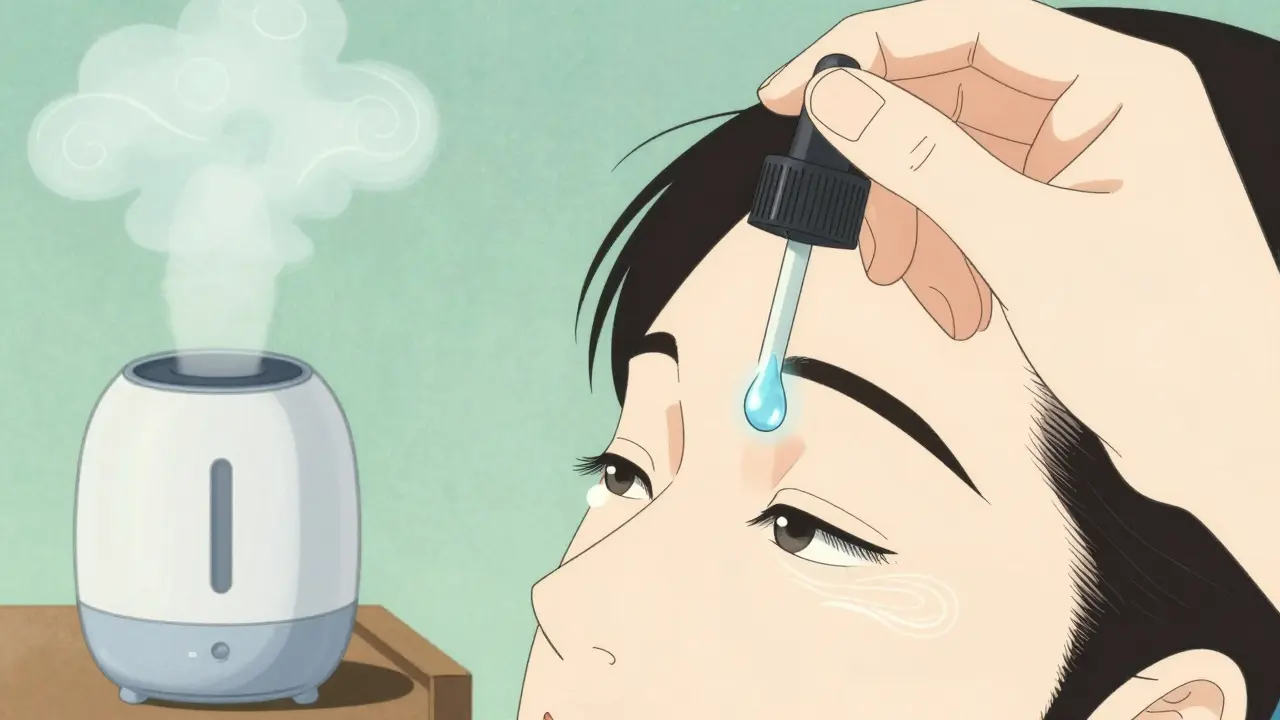
- Don't Touch Your Eye: Hold the bottle tip about 1 centimeter away from your eye. Touching your cornea with the dropper can cause scratches and introduce bacteria.
- Use One Drop: More is not better. Your eye can only hold one drop at a time. Extra drops just run down your cheek. New users often apply 2.3 drops on average, but one is sufficient.
- Wait Between Medications: If you use other eye drops, wait at least 5 minutes between applications. Otherwise, the second drop washes out the first one before it can work.
- Cool Them Down: Refrigerating your drops increases their viscosity slightly. This can extend the residence time on your eye by 22%, giving you longer-lasting relief and a soothing sensation.
Many people complain that drops blur their vision. This is normal with thicker, gel-like formulas. If you wear contact lenses, ensure you use drops labeled as "contact lens compatible." Standard artificial tears can bind to soft lenses, turning them cloudy and uncomfortable. Brands like Retaine HPMC or Systane Ultra are often cited by users as being gentler on lenses.
When Artificial Tears Aren't Enough
If you are using drops five or more times a day and still feel pain, grittiness, or fluctuating vision, artificial tears alone may not solve the problem. About 28% of patients stop using them within six months because they don't provide adequate long-term relief. This is especially true for evaporative dry eye, where the underlying issue is gland dysfunction, not just lack of fluid.
In these cases, you need to address the inflammation. Chronic dry eye creates a vicious cycle: tear instability leads to hyperosmolarity (high salt concentration), which triggers inflammatory mediators like IL-1 and TNF-α. These chemicals damage the ocular surface, making it harder for tears to stick, which causes more evaporation. Breaking this cycle requires prescription treatments.
Options include:
- Cyclosporine (Restasis): An immunomodulator that reduces inflammation and helps your body produce more natural tears.
- Lifitegrast (Xiidra): Another anti-inflammatory drop that targets specific immune pathways involved in dry eye.
- Punctal Plugs: Tiny inserts placed in your tear ducts to block drainage, keeping your natural and artificial tears on the eye longer. However, 23% of people experience spontaneous extrusion, meaning the plug falls out.
- Neurostimulation (TrueTear): A newer device that stimulates nerves to increase natural tear production, showing a 31.2% increase in ADDE patients.
If over-the-counter drops fail after 4-6 weeks, see an ophthalmologist or optometrist specializing in ocular surface disease. They can perform tests like the Schirmer test (measuring tear volume) or measure tear osmolarity with a device like the TearLab system. Values above 308 mOsm/L indicate significant dry eye disease.
Managing Dry Eye in Daily Life
Treatment isn't just about drops. Lifestyle changes play a massive role, especially since digital eye strain has increased DES risk by 28%. We blink less when looking at screens-dropping from 15 blinks per minute to just 5-7. Each incomplete blink fails to spread the oil layer evenly, accelerating evaporation.
Try the 20-20-20 rule: every 20 minutes, look at something 20 feet away for 20 seconds. This encourages full blinking. Also, consider using a humidifier in dry climates or during winter heating seasons. Warm compresses applied to closed eyelids for 10 minutes daily can help unclog Meibomian glands, improving the quality of the lipid layer in EDE cases.
Remember, dry eye is a chronic condition for many. It requires consistent management, not just quick fixes. By understanding your specific type of dry eye and choosing the right combination of drops, lifestyle adjustments, and medical treatments, you can maintain comfort and protect your vision.
What is the difference between ADDE and EDE?
ADDE (Aqueous Tear-Deficient Dry Eye) occurs when your eyes do not produce enough water-based tears, often due to aging or autoimmune diseases like Sjogren's. EDE (Evaporative Dry Eye) happens when tears evaporate too quickly because the oily lipid layer is deficient, usually caused by Meibomian Gland Dysfunction. EDE is much more common, accounting for about 86% of cases.
Should I use preservative-free artificial tears?
If you use eye drops more than four times a day, yes. Preservatives like benzalkonium chloride (BAK) can irritate the eye surface with frequent use. Preservative-free single-dose vials are safer for heavy users and provide better symptom improvement in severe cases.
Why do my eyes water if I have dry eye?
This is a reflex response. When your eyes detect irritation or dryness, they signal the brain to flood the eye with watery tears. However, these reflex tears lack the necessary oils and proteins to stay on the eye, so they run off quickly, leaving you feeling dry again shortly after.
Can dry eye cause permanent vision damage?
In severe, untreated cases, yes. Chronic inflammation can lead to corneal scarring and ulcers, potentially resulting in permanent vision loss. While rare (affecting about 4.3% of chronic cases), it highlights the importance of proper diagnosis and treatment beyond just using over-the-counter drops.
How long should artificial tears last?
Standard saline drops may only last 2.5 hours, while thicker formulations with hyaluronic acid can provide relief for up to 4.2 hours. However, individual results vary based on the severity of your dry eye and environmental factors. If you need relief more frequently than every few hours, consult an eye doctor for stronger treatments.