How to Measure Children’s Medication Doses Correctly at Home

Getting the right dose of medicine for your child isn’t just important-it can be life-saving. A mistake of just one milliliter can mean the difference between treatment and harm. Around 7 in 10 parents mess up liquid medication doses at home, often because they’re using the wrong tools or misunderstanding the numbers on the label. This isn’t about being careless. It’s about confusion-between milligrams and milliliters, between teaspoons and syringes, between what’s written and what’s actually measured.
Why Measuring Correctly Matters More for Kids
Children aren’t small adults. Their bodies process medicine differently, and even tiny errors can have big consequences. A dose that’s too low might not fight an infection. A dose that’s too high can cause seizures, liver damage, or worse. The CDC estimates that over 7,000 children end up in emergency rooms each year because of preventable medication errors-most of them from liquid medicines given at home.
Here’s the hard truth: a kitchen teaspoon isn’t a teaspoon. In your kitchen, it might hold anywhere from 4 to 7 milliliters. But a real teaspoon of medicine? That’s exactly 5 mL. If you’re giving your child 2.5 mL of amoxicillin using a kitchen spoon, you might be giving them 3.5 mL-or even 5 mL. That’s a 40% to 100% overdose. For a 15-pound baby, that’s dangerous.
Use Only mL-Not Teaspoons or Tablespoons
The American Academy of Pediatrics and the CDC agree: never use teaspoons or tablespoons to measure children’s medicine. Ever. Even if the label says “1 tsp,” it should also say “5 mL.” If it doesn’t, call your pharmacist. They’ll give you the right measurement.
Since 2015, experts have pushed for mL-only labeling on all pediatric medications. Today, 78% of liquid medicines use mL only-up from just 42% in 2015. But that still means 1 in 5 bottles might confuse you. Don’t guess. Always check for the mL number. If you see “tsp” or “tbsp,” ask for clarification. You have the right to know exactly what you’re giving.
The Right Tools for the Job
Not all measuring tools are created equal. Here’s what works-and what doesn’t:
- Oral syringes (1-10 mL): The gold standard. They’re accurate, easy to control, and let you give medicine slowly. For doses under 5 mL, they’re the only tool you should use. Studies show they’re 94% accurate.
- Dosing cups (5-30 mL): Fine for older kids who can drink from a cup. But for small doses, they’re risky. Error rates jump to nearly 70% when measuring 2.5 mL in a cup.
- Droppers: Good for newborns or tiny doses. Make sure they’re marked in mL, not just “drops.” Drops vary too much to be reliable.
- Medication spoons: Only if they’re labeled in mL. Most household spoons aren’t.
- Kitchen spoons: Never use these. They’re not calibrated. They’re dangerous.
Many pharmacies now give you a free oral syringe with your child’s prescription. If they don’t, ask for one. Some brands like NurtureShot and Medisana BabyDos have color-coded syringes that match common doses, making it easier to avoid mistakes.
How to Measure with an Oral Syringe
Using a syringe sounds simple-but most people do it wrong. Here’s how to get it right:
- Shake the bottle if it’s a suspension (like amoxicillin or ibuprofen). If you don’t, the medicine settles at the bottom. You could end up giving your child only half the dose.
- Draw up the exact amount using the syringe. Don’t guess. Look at the mL markings on the side.
- Hold the syringe vertically and level with your eyes. Read the line where the liquid curves (the meniscus). Don’t look from above or below.
- Insert the tip gently into the side of your child’s mouth, near the cheek. This avoids triggering the tongue-thrust reflex that makes kids spit it out.
- Push slowly. Let your child swallow between small pushes. Don’t squirt it all at once.
Pro tip: Use a permanent marker to write the dose on the syringe if you give the same amount every day. That way, you’re less likely to misread it when you’re tired or stressed.

Weight-Based Dosing: The Math You Need to Know
Many pediatric doses are based on your child’s weight-not age. The label might say “10 mg/kg.” That means 10 milligrams per kilogram of body weight.
Here’s how to convert pounds to kilograms:
- Divide your child’s weight in pounds by 2.2.
- Example: A child weighing 22 pounds = 22 ÷ 2.2 = 10 kg.
Now, if the dose is 40 mg/kg/day divided into two doses, you’d calculate:
- 40 mg × 10 kg = 400 mg total per day
- 400 mg ÷ 2 = 200 mg per dose
If the medicine is 400 mg per 5 mL, then:
- 200 mg is half of 400 mg
- So, half of 5 mL = 2.5 mL
Always double-check this math with your pharmacist. Don’t trust yourself if you’re unsure. It’s better to ask twice than to give the wrong dose once.
What to Do When Your Child Refuses Medicine
More than 60% of parents say their child refuses medicine. That’s normal. But mixing it with juice or food can mess up the dose.
Safe tricks:
- Use a syringe to place the dose in the cheek, not the front of the mouth.
- Ask your pharmacist if the medicine can be mixed with a small amount of applesauce or yogurt. Only use a teaspoon of food-not a whole spoonful.
- Try flavored versions. Many pharmacies offer flavoring options like cherry, bubblegum, or grape.
- Don’t force it. If your child gags or spits it out, wait a few minutes and try again.
Never mix medicine into a full bottle of milk or juice. If your child doesn’t drink it all, they won’t get the full dose.
Common Mistakes and How to Avoid Them
Here are the top errors parents make-and how to stop them:
- Confusing mg and mL: One is a weight, one is a volume. They’re not the same. Always check both numbers on the label.
- Using the wrong syringe: A 1 mL syringe is for tiny doses. A 10 mL syringe is for larger ones. Don’t use a big syringe for a 0.5 mL dose-it’s hard to read accurately.
- Not shaking suspensions: If the medicine looks cloudy or separates, shake it well for 10 seconds before measuring.
- Using old medicine: Liquid antibiotics often expire after 14 days, even if the bottle says otherwise. Check the label or ask your pharmacist.
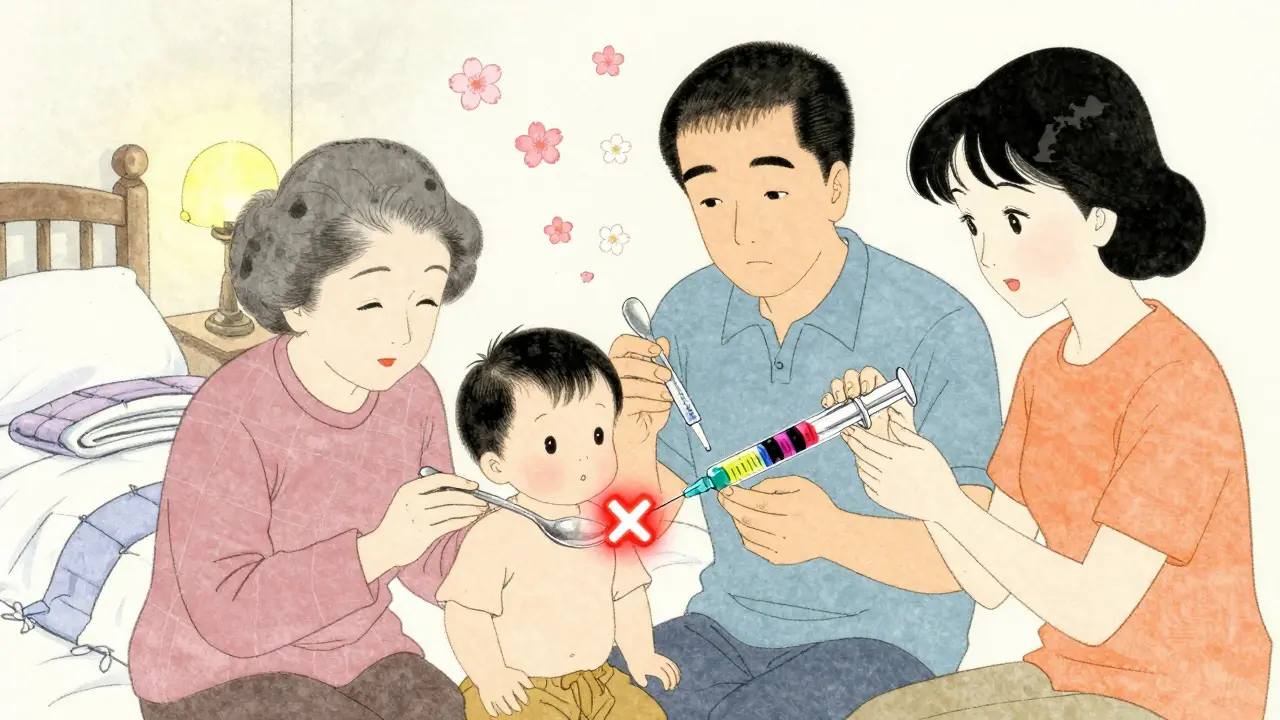
- Multiple caregivers: If grandma, dad, and mom all give medicine, make sure everyone uses the same tool and reads the same label. Write down the dose and time on a chart.
What to Do If You’re Not Sure
When in doubt, call your pharmacist. They’re trained to help with this. Don’t wait until your child gets sick. Ask ahead of time: “Can you show me how to measure this correctly?”
Also, take a photo of the label and the syringe reading before you give the dose. That way, if you’re confused later, you can look back.
Some hospitals now offer free apps like MedSafety that use your phone’s camera to scan the bottle and show you how to measure the dose. They even have video demos. Ask your doctor if one is available.
What’s Changing in 2025 and Beyond
The FDA is pushing for a new rule: all pediatric liquid medications must come with a built-in oral syringe labeled only in mL. That’s expected to roll out fully by 2026. Until then, don’t wait. Get your own syringe now.
Smart dosing cups that beep when you’ve measured the right amount are in development and expected to hit the market in 2025. But for now, the simplest tool-the oral syringe-is still the most reliable.
One final thing: if you’re low-income, you’re more likely to make a dosing error-not because you’re careless, but because you might not have access to proper tools. Many clinics and pharmacies offer free oral syringes. Ask for them. You deserve safe care for your child.
Final Checklist Before Giving Medicine
- ✅ Is the dose written in mL, not tsp or tbsp?
- ✅ Do I have the right tool? (Oral syringe for doses under 5 mL)
- ✅ Did I shake the bottle if it’s cloudy?
- ✅ Did I convert pounds to kilograms if the dose is weight-based?
- ✅ Did I read the syringe at eye level?
- ✅ Did I double-check with my pharmacist if I’m unsure?
Medication safety isn’t about being perfect. It’s about being careful. One extra second to check the syringe can keep your child safe.
Matthew Hekmatniaz
January 1, 2026 AT 14:04Just wanted to say this post saved my life last month. My daughter had strep and I was using a kitchen spoon because I didn’t know better. After reading this, I went to the pharmacy and got a free syringe. She took her meds without a fight, and I actually slept that night. Thanks for the clarity.
Liam George
January 3, 2026 AT 08:59Let’s be real - this whole ‘mL-only’ push is just Big Pharma’s way of making parents dependent on their tools. They don’t want you to trust your instincts. Why do you think they stopped using teaspoons? Because they knew you’d start measuring your own doses with household items and cut their profits. The FDA’s ‘2026 rule’? A distraction. Look at the real data - most overdoses happen in hospitals, not homes. They’re scared of decentralized care.
sharad vyas
January 5, 2026 AT 07:20In India, we often use the same spoon for everything - tea, medicine, curry. I never thought it was dangerous until I saw my cousin’s baby get sick. Now I keep a small syringe in my bag. It’s not about money. It’s about respect - for the child, for the medicine, for the science. Simple tools, simple care.
Dusty Weeks
January 5, 2026 AT 23:29OMG I JUST REALIZED I’VE BEEN USING A KITCHEN SPOON FOR 3 YEARS 😭😭😭 THANK YOU FOR THIS POST!! I JUST WENT AND BOUGHT A SYRINGE AND NOW I’M CRYING IN THE PHARMACY AISLE 😂❤️
jaspreet sandhu
January 6, 2026 AT 14:38You say never use kitchen spoons but you ignore the reality of millions of families who don’t have access to syringes. You talk about accuracy but not about equity. What about the single mom working two jobs who can’t afford to go to the pharmacy? What about the rural areas where pharmacies don’t even stock these tools? You give advice like it’s free, but safety isn’t free - it’s a privilege. This post feels like preaching to the choir while the rest of us are drowning.
Bryan Anderson
January 8, 2026 AT 01:18This is one of the most thoughtful and well-researched pieces on pediatric dosing I’ve seen. The breakdown of tools, the emphasis on weight-based calculations, and the reminder to consult pharmacists are all critical. I’ve shared this with my entire family - grandparents, aunts, uncles. Everyone needs to see this. Thank you for making it so clear and actionable.
Sally Denham-Vaughan
January 9, 2026 AT 14:07My kid used to spit out everything. Then I found out the pharmacy will flavor it for free. I got bubblegum amoxicillin and now she asks for it like it’s candy. Also, I write the dose on the syringe with a Sharpie. Works like a charm. PS: I keep the syringe in the fridge with the medicine. Keeps it clean and ready.
Bill Medley
January 11, 2026 AT 05:28Accurate dosing is non-negotiable. Oral syringes are the standard. Always verify mL. Consult pharmacists. No exceptions.
Richard Thomas
January 11, 2026 AT 19:19I’ve spent years thinking about how medical authority shapes parental behavior. The shift from teaspoons to mL isn’t just about precision - it’s about the erosion of folk knowledge. We used to trust intuition, family wisdom, the rhythm of care. Now we’re told to rely on calibrated tools and institutional guidance. Is that progress? Or just another way we’ve been made to feel inadequate? I’m not saying we should go back - but we should acknowledge the emotional weight of this change. For many, it’s not just about measuring liquid - it’s about measuring worth.
Paul Ong
January 12, 2026 AT 05:08Shake the bottle before you draw it up. Use the syringe. Don’t guess. Write it down. Ask the pharmacist. That’s it. No drama. No fluff. Just do it. Your kid’s life depends on it. No excuses.
Andy Heinlein
January 12, 2026 AT 10:29Just got my kid’s new prescription and the pharmacist handed me a free syringe with a little sticker that said ‘You got this!’ I cried. Not because it was expensive - because someone cared enough to give it to me like I was doing something brave. This post made me feel less alone. Thank you.
Ann Romine
January 12, 2026 AT 21:04I’m from a culture where medicine is often mixed with honey or warm milk. This post made me realize how risky that can be - not because I’m careless, but because I never had the right information. Now I use the syringe and ask questions. It’s a small change, but it feels like a big step.
Todd Nickel
January 13, 2026 AT 01:12The most overlooked point here is the meniscus. Most people read the syringe from above, which leads to significant over-dosing. The curvature of the liquid - the meniscus - must be aligned with the marking at eye level. This is basic fluid dynamics, yet it’s rarely taught to parents. Even among healthcare workers, this mistake is common. The fact that the CDC and AAP emphasize mL-only labeling is good, but without teaching proper reading technique, we’re still leaving families vulnerable. This needs to be part of every pediatric discharge packet - not just a footnote.