Hypothyroidism and Statins: How Thyroid Status Increases Myopathy Risk
Hypothyroidism & Statin Risk Calculator
Enter your information to see your risk level
When you have hypothyroidism and your doctor prescribes a statin to lower your cholesterol, you might not realize you’re stepping into a hidden risk zone. It’s not just about taking two common medications-it’s about how they interact inside your body. The combination can dramatically increase your chance of muscle damage, even leading to a life-threatening condition called rhabdomyolysis. This isn’t theoretical. Real patients have ended up in the hospital with creatine kinase (CK) levels over 15,000 U/L-10 times the normal limit-because their thyroid wasn’t properly managed while on statins.
Why This Interaction Happens
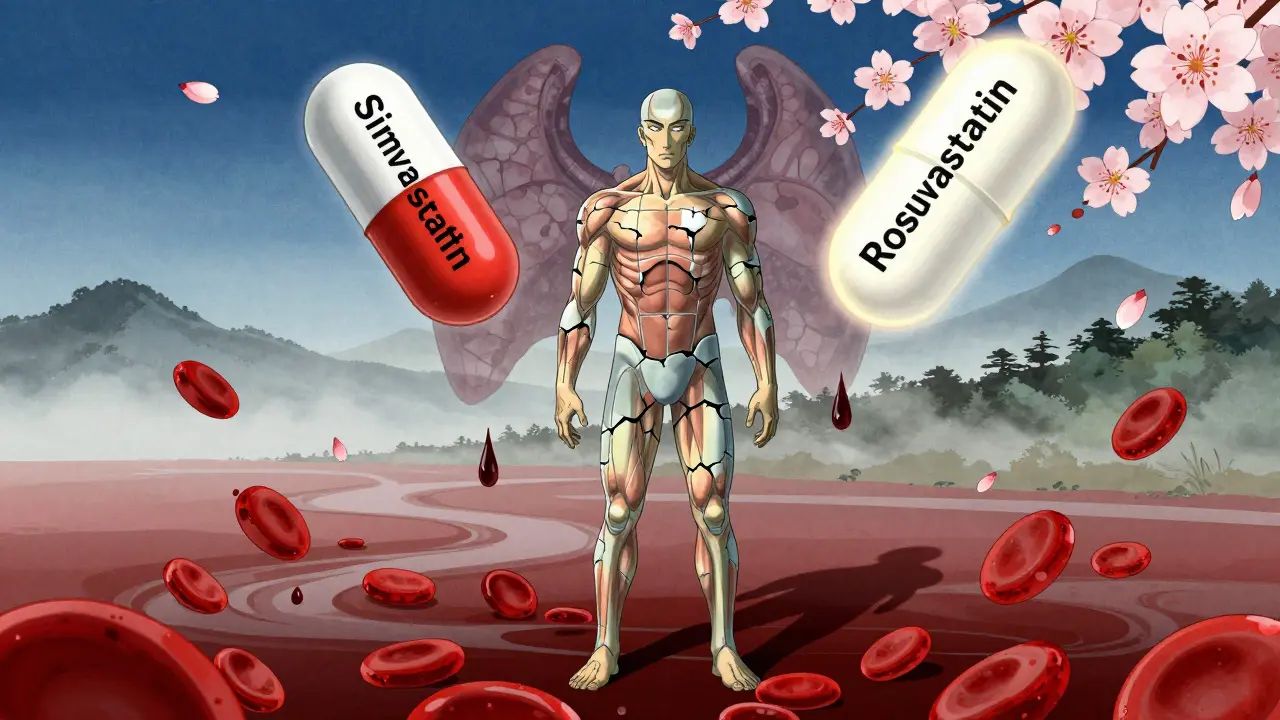
Your muscles need energy to function. That energy comes from mitochondria, the powerhouses inside your cells. Hypothyroidism slows down your metabolism, which directly weakens mitochondrial function. At the same time, statins reduce levels of coenzyme Q10 (CoQ10), a compound your body needs to produce energy. When both happen together, your muscles are hit from two sides: less fuel and less ability to use what’s left. A 2015 study in Atherosclerosis found statins can cut CoQ10 by 25-50%. In someone with untreated hypothyroidism, that drop hits harder and faster.There’s another layer: your liver. Hypothyroidism reduces the activity of CYP3A4, the main enzyme that breaks down most statins-especially simvastatin, atorvastatin, and lovastatin. When this enzyme slows down, your body can’t clear the statin efficiently. As a result, statin levels in your blood can rise 30-50%. That means more drug sitting in your muscles, doing more damage. A 2017 study in Clinical Pharmacology & Therapeutics confirmed this buildup in hypothyroid patients, even at standard doses.
Thyroid Levels Matter More Than You Think
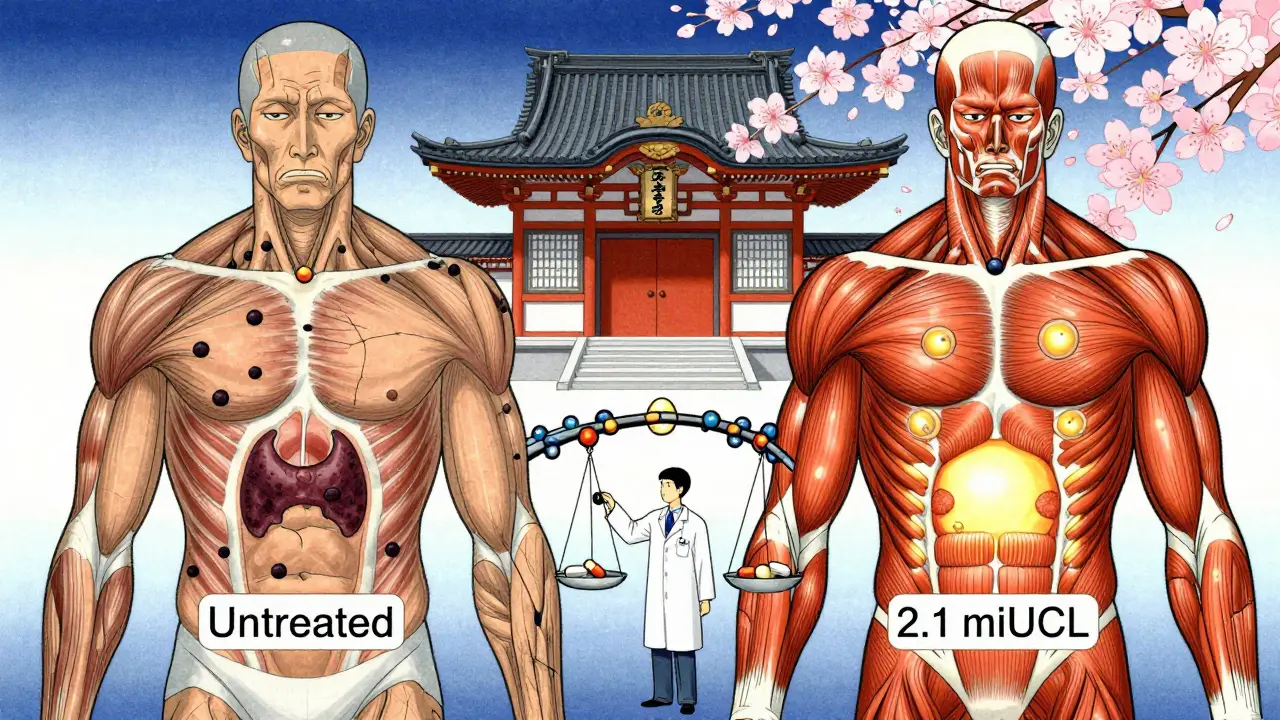
It’s not just about whether you’re hypothyroid. It’s about how hypothyroid you are. TSH (thyroid-stimulating hormone) levels tell the story. If your TSH is above 10 mIU/L, your risk of statin-induced myopathy jumps 4.2 times compared to someone with normal thyroid function. Even subclinical hypothyroidism-where TSH is between 4.5 and 10 mIU/L-doubles your risk. A 2019 study of over 12,000 people showed this clearly. And here’s the kicker: many people with mild thyroid issues don’t even know it. They feel tired, put on a few pounds, and chalk it up to aging. But their thyroid could be silently amplifying statin damage.Real-world data backs this up. A Healthline survey of 1,245 statin users with hypothyroidism found that 73% of those who developed muscle pain had TSH levels above 4.5 mIU/L when symptoms started. And when their thyroid was corrected-usually by adjusting levothyroxine-89% of them saw their muscle pain disappear within 4 to 6 weeks.
Not All Statins Are Created Equal
The type of statin you take makes a huge difference. Lipophilic statins-like simvastatin, atorvastatin, and lovastatin-easily slip into muscle cells. Hydrophilic statins-like pravastatin and rosuvastatin-don’t. In a 2021 meta-analysis, lipophilic statins carried 2.3 times higher myopathy risk in hypothyroid patients than hydrophilic ones.Simvastatin at 40 mg or higher is especially dangerous. In hypothyroid patients, it causes myopathy in 12.7% of cases-nearly 6 times higher than in people with normal thyroid function. That’s why the 2022 American College of Cardiology guidelines say: avoid high-dose simvastatin in anyone with hypothyroidism. The risk of rhabdomyolysis is 15 times higher than with lower doses.
On the flip side, rosuvastatin at 10-20 mg/day is the safest option. It increases myopathy risk by only 1.4 times in hypothyroid patients, compared to 3.2 times for atorvastatin. Pravastatin isn’t far behind, with just 1.3% incidence in hypothyroid patients. For someone with thyroid issues, these are the statins to consider first.
What Doctors Should Do
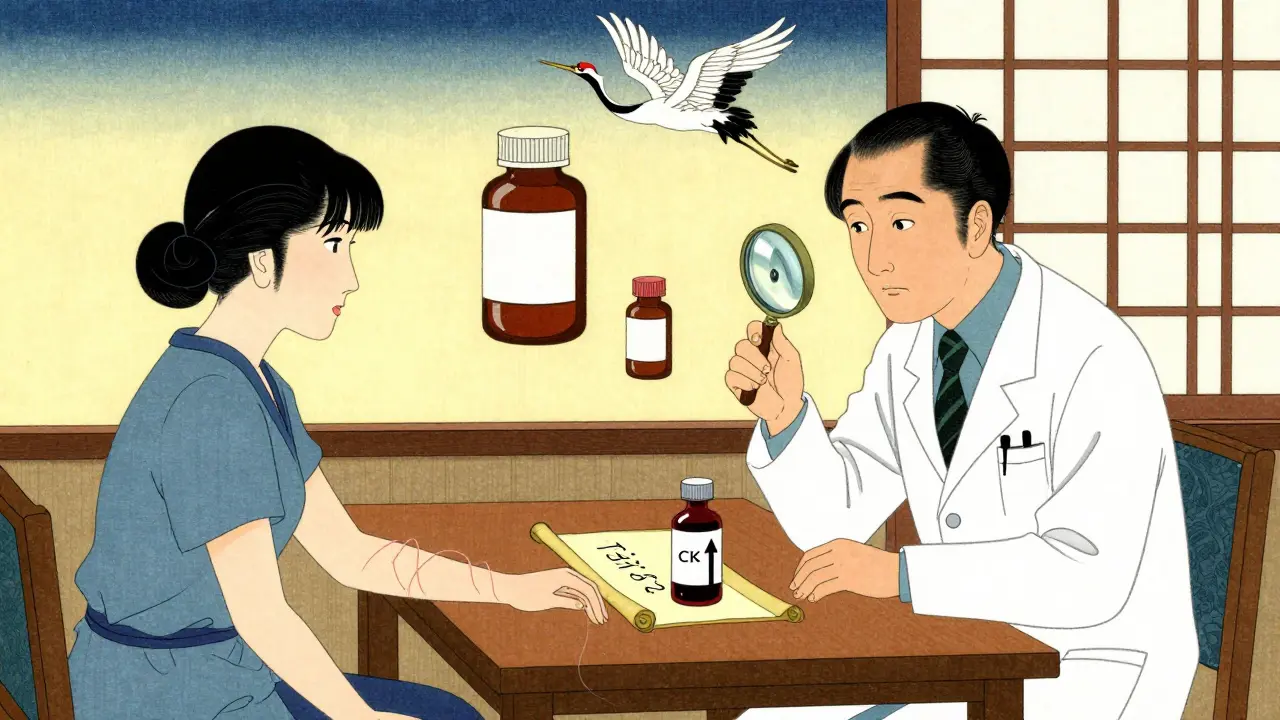
The standard of care is clear. Before starting any statin, check TSH and free T4. If TSH is above 4.0 mIU/L, treat the hypothyroidism first. Don’t just start the statin and hope for the best. The 2023 American Thyroid Association guidelines recommend bringing TSH down to 0.5-3.0 mIU/L before initiating statin therapy. That’s not a suggestion-it’s a requirement to avoid serious harm.After starting the statin, monitor again at 6-8 weeks. Muscle pain, weakness, or dark urine? Check CK levels. If CK is over 10 times the upper limit of normal-or over 5 times with symptoms-stop the statin. Don’t wait for rhabdomyolysis to set in. A 2023 case report described a 67-year-old woman who developed kidney failure and required dialysis because her TSH hit 22.4 mIU/L while she kept taking simvastatin 40 mg daily. She was being treated for thyroid cancer, and no one thought to pause her statin.
What You Can Do
If you have hypothyroidism and are on a statin:- Ask your doctor for your latest TSH result. If it’s above 4.0, ask if your dose needs adjusting.
- If you’re on simvastatin, especially 40 mg or higher, ask if switching to rosuvastatin or pravastatin is an option.
- Report any new muscle pain, cramps, or weakness-even if they seem mild. Don’t assume it’s just aging.
- Consider CoQ10 supplementation. A 2020 randomized trial showed 200 mg/day reduced muscle pain by over 50% in hypothyroid statin users. It’s not FDA-approved for this use, but it’s backed by solid science.
One Reddit user, HypoWarrior2022, described how their CK spiked to 8,400 U/L after starting atorvastatin while their TSH was 9.2. They had to stop all meds for three weeks and adjust their levothyroxine. Their symptoms vanished after thyroid levels normalized. Their story isn’t rare-it’s predictable.
The Bigger Picture
About 20 million Americans have hypothyroidism. Nearly 40 million take statins. That means millions are potentially at risk. A 2022 study found that 32.4% of hypothyroid patients stopped their statin within a year because of muscle pain-compared to just 14.7% of those with normal thyroid function. That’s over 6 million people who may have unnecessarily given up a life-saving drug.But here’s the good news: when thyroid function is optimized, 85-90% of hypothyroid patients can safely stay on statins. A 2023 meta-analysis in Circulation showed no increased risk of heart attack or stroke in these patients-once their TSH was in range. The problem isn’t statins. The problem is uncontrolled hypothyroidism.
Future tools are coming. A 2023 study in Nature Medicine identified a genetic score that predicts statin myopathy risk in hypothyroid patients with 82% accuracy. Trials like THYROSIMVASTATIN are now testing personalized risk calculators that could tell you, before you even start, whether a statin is safe for you. But for now, the answer is simple: check your thyroid before you start, and keep it checked.
Can hypothyroidism cause muscle pain even without statins?
Yes. Hypothyroidism itself can cause muscle stiffness, cramps, and weakness because low thyroid hormone slows down muscle metabolism and reduces energy production. But when you add a statin, the damage multiplies. Statins don’t cause muscle pain in everyone, but in someone with untreated hypothyroidism, the risk jumps dramatically.
Should everyone with hypothyroidism avoid statins?
No. Statins are still one of the most effective ways to prevent heart attacks and strokes in high-risk patients. The key is to treat the hypothyroidism first. Once TSH is in the target range (0.5-3.0 mIU/L), most people can safely take statins-especially safer ones like rosuvastatin or pravastatin. Avoiding statins entirely can be more dangerous than the risk of myopathy.
Is CoQ10 supplementation recommended for people with hypothyroidism on statins?
While not officially mandated in guidelines, CoQ10 supplementation at 200 mg daily has been shown in clinical trials to reduce muscle pain by over 50% in hypothyroid patients taking statins. It’s an evidence-backed, low-risk option. Since CoQ10 levels drop with both hypothyroidism and statins, replacing it makes biological sense. Talk to your doctor before starting-it’s safe for most people, but not a substitute for thyroid treatment.
What are the signs of statin-induced myopathy?
Look for unexplained muscle pain, tenderness, or weakness-especially in the shoulders, thighs, or lower back. Dark, cola-colored urine is a red flag for rhabdomyolysis, meaning muscle tissue is breaking down and releasing toxins into the bloodstream. Fatigue, fever, and nausea can also occur. If you notice these symptoms while on a statin and have hypothyroidism, get your CK levels checked immediately.
How often should TSH be checked if I’m on both levothyroxine and a statin?
Check TSH before starting the statin. Then again 6-8 weeks after starting or changing the statin dose. After that, annual checks are usually enough if your thyroid levels are stable. But if you develop muscle symptoms, check TSH and CK right away. Many cases of myopathy are triggered by changes in thyroid hormone levels-like after a dose adjustment or during illness.
jared baker
March 18, 2026 AT 01:23Been there. TSH was 9.2, on simvastatin 40mg. Muscle pain so bad I could barely lift my coffee cup. Doctor said "it's just aging." I pushed back, got my thyroid checked, adjusted levothyroxine, switched to rosuvastatin 10mg. Gone in 3 weeks. No drama. Just science.
Don't let anyone tell you it's "all in your head." This is real, measurable, and totally preventable.
Michelle Jackson
March 18, 2026 AT 19:49People really think they can just take two pills and expect their body to cooperate? You don't get to pick which systems ignore each other. Hypothyroidism doesn't care if you're "statin compliant." Your liver doesn't get a vote. Your muscles? They just scream until something breaks.
David Robinson
March 20, 2026 AT 15:03Look, I get it. You're scared of statins. You read a Reddit post and now you think your thyroid is the villain. But here's the truth: if your TSH is above 4.0, you're already at risk for heart disease. Statins save lives. The real issue is lazy endocrinologists who don't test TSH before prescribing. That's the systemic failure-not the drugs.
And no, CoQ10 isn't a magic bullet. It's a Band-Aid on a broken artery. Fix the root cause. Treat the thyroid. Then reevaluate. Stop treating symptoms like they're the disease.
Jeremy Van Veelen
March 22, 2026 AT 14:23Oh my god. This is the most terrifying thing I've read since the day I found out my mom's cholesterol was "normal" but her mitochondria were basically on life support.
Imagine your cells-your very powerhouses-being slowly starved by two perfectly legal, perfectly prescribed medications. It's like your body is a Tesla being fed diesel. And no one tells you? No one warns you? This isn't medicine. This is a silent massacre.
Laura Gabel
March 23, 2026 AT 03:22Statins are overhyped. Thyroid people are just weak. Stop taking pills. Eat clean. Walk more. Done.
Also TSH 4.0 is nonsense. My cousin's dog has a lower TSH than some of these patients.
jerome Reverdy
March 23, 2026 AT 06:20As someone who’s managed both hypothyroidism and hyperlipidemia for 12 years, this is spot on. The jargon-heavy stuff? Yeah, it’s dense. But here’s the distilled version: mitochondria are the batteries. CoQ10 is the charge. Thyroid is the power regulator. Statins? They drain the battery. Do the math.
Switched from atorvastatin to pravastatin. TSH stabilized at 1.8. Muscle pain? Vanished. CoQ10? Still taking it. Why not? It’s cheap, safe, and makes biological sense. No one’s forcing you. But if you’re smart, you’ll do the same.
Andrew Mamone
March 23, 2026 AT 22:24Just wanted to say THANK YOU for writing this. 🙏
My TSH was 7.1 when I started atorvastatin. Three weeks later, I could barely climb stairs. CK was 12,000. I thought I was dying. Turns out I just needed my thyroid fixed. Now I’m on rosuvastatin 10mg. TSH 2.4. Zero pain. I feel like a 35-year-old again.
Check your numbers. Don’t wait for a crisis.
MALYN RICABLANCA
March 25, 2026 AT 17:20Oh my GOD, this is EXACTLY what happened to me!! I was on simvastatin 40mg for 6 months and I thought I was just getting old-until I started peeing cola-colored urine and my legs felt like wet noodles!! I almost ended up in dialysis!! My endo was like "oh, maybe your thyroid is off?"-as if that’s a side note!! I had to beg for a TSH test!!
Now I’m on rosuvastatin 10mg, CoQ10 200mg daily, and my levothyroxine is dialed in. I’m alive. And I will NEVER let another doctor dismiss my muscle pain as "just aging."
THIS NEEDS TO BE A STANDARD OF CARE. NOT A "SUGGESTION."
gemeika hernandez
March 26, 2026 AT 16:33My mom had this. She didn't even know she was hypothyroid. Took simvastatin. Got super weak. Thought it was arthritis. Then she couldn't get out of bed. CK was through the roof. They put her on IV fluids. She was in the hospital for 10 days.
Now she's on pravastatin. TSH is 2.1. Feels like a new person.
Doctors need to check TSH before statins. Period.
Nicole Blain
March 28, 2026 AT 02:21This gave me chills. 😳
I’ve been on levothyroxine for 8 years. Started statin last year. Mild leg cramps. Thought it was just my yoga routine. Now I’m getting my TSH checked tomorrow. Thanks for the wake-up call 💙
Kathy Underhill
March 28, 2026 AT 16:49There’s a quiet dignity in treating the body as a system, not a collection of symptoms.
Thyroid function isn’t a checkbox. It’s the foundation. Statins aren’t inherently dangerous. But they’re not neutral either. They interact. They cascade.
When we treat one part without seeing the whole, we don’t heal. We just delay the collapse.
Check TSH. Not because it’s trendy. Because it’s necessary.
Srividhya Srinivasan
March 29, 2026 AT 11:40Big Pharma knows this. They hide it. Why? Because if people knew how dangerous statins are with thyroid issues, they’d stop buying them. And what then? Who profits? The supplement companies? The thyroid labs? The "natural health" gurus? This is all a cover-up. The real cure? Fasting. Cold showers. And avoiding corporate medicine entirely.
jared baker
March 31, 2026 AT 04:33@8081 - you’re missing the point. This isn’t about Big Pharma. It’s about doctors not checking TSH. I’m not anti-pharma. I’m pro-checking-numbers. The data is clear. The guidelines exist. The fix is simple. Stop blaming corporations. Start demanding basic care.