MAOI Dietary Restrictions: Tyramine Triggers and Safety Plan
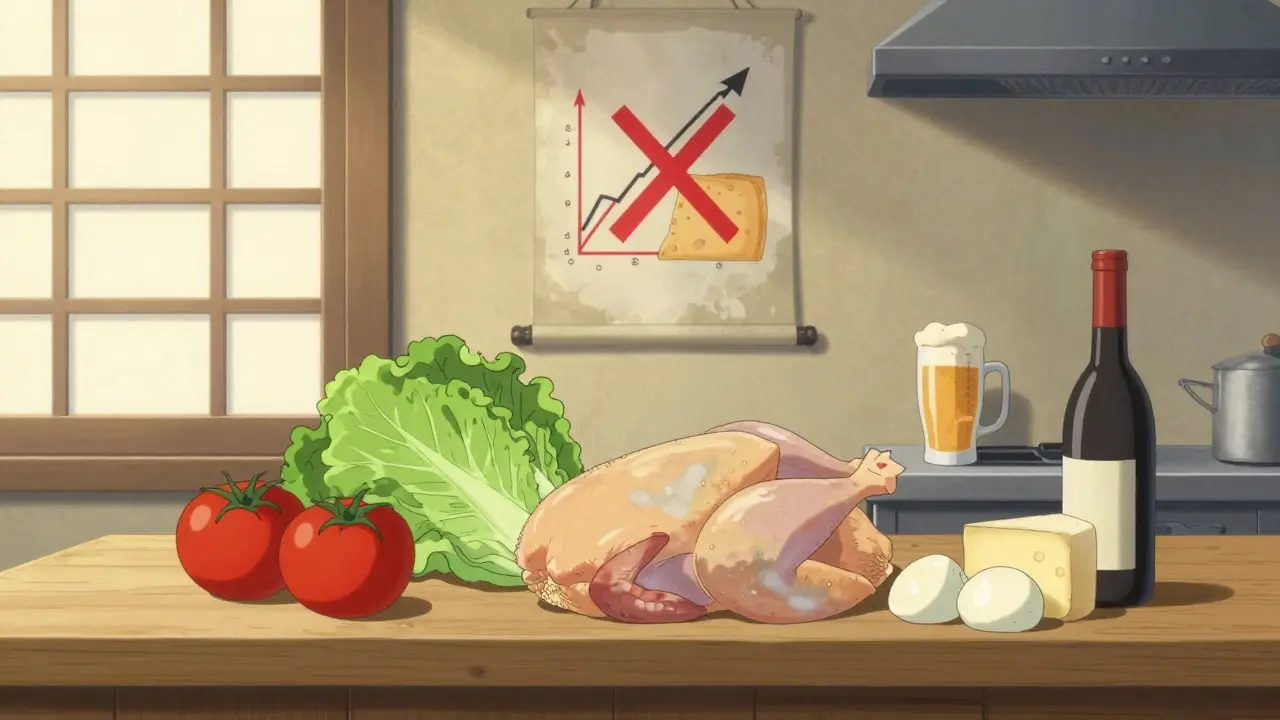
Tyramine Safety Calculator
How This Calculator Works
Calculate tyramine content in your meal to avoid hypertensive crises. The recommended safe limit is 6 mg of tyramine per serving. Exceeding this limit increases your risk of dangerous blood pressure spikes.
Your Meal
Safe Meal
Your meal contains 0 mg of tyramine. This is below the recommended safe limit of 6 mg per serving.
When you’re on an MAOI antidepressant, your food choices aren’t just about taste or health-they can be life-or-death. Monoamine oxidase inhibitors like phenelzine, tranylcypromine, and isocarboxazid work differently than SSRIs or SNRIs. They stop your body from breaking down excess tyramine, a compound naturally found in aged, fermented, or spoiled foods. When tyramine builds up, it can spike your blood pressure dangerously fast-sometimes to levels that cause stroke or heart attack. This isn’t theoretical. The first documented case happened in 1964, when a patient eating cheddar cheese while on phenelzine suffered a hypertensive crisis. Today, that risk is better understood, and the rules have changed-but only if you know what to look for.
Which MAOIs Require Strict Dietary Rules?
Not all MAOIs are the same. The older, irreversible oral versions-phenelzine (Nardil), tranylcypromine (Parnate), and isocarboxazid (Marplan)-require strict dietary control. These drugs block nearly all monoamine oxidase-A in your gut and liver, leaving tyramine unchecked. Even small amounts from a single meal can trigger a reaction.The transdermal patch selegiline (Emsam) is different. At the lowest dose (6 mg/24 hours), it mostly targets MAO-B, not MAO-A, so your gut can still break down tyramine. That means you don’t need to avoid most foods. But if you’re on 9 mg or 12 mg patches, you’re back to full restrictions. Always check your dose. A mistake here can be deadly.
What Foods Actually Raise Tyramine Levels?
Forget everything you heard from the 1980s. Modern food production has changed everything. Back then, cheddar cheese could have over 100 mg of tyramine per 100 grams. Today, properly refrigerated commercial cheddar has less than 1 mg. But some foods still carry risk-especially if they’re old, improperly stored, or homemade.Here’s what you need to avoid:
- Aged cheeses: Blue cheese, parmesan, asiago, and cheddar aged more than 6 months. These can hit 20-50 mg per 100g. Fresh cheeses like cottage cheese, ricotta, and mozzarella are safe.
- Tap and unpasteurized beer: Draft beer can have 5-19 mg per 100g. Bottled pasteurized beer is fine in moderation. Avoid homebrews and kegs.
- Dry fermented sausages: Salami, pepperoni, and summer sausage contain 25-150 mg per 100g. Cooked meats like deli ham or roasted turkey are okay.
- Improperly stored fish: Smoked or pickled fish stored past 48 hours can spike to 200 mg per 100g. Fresh, refrigerated fish is safe.
- Soy sauce and miso: Soy sauce can have 10-118 mg per 100g. Tofu is okay in small amounts (100g, max twice a week). Avoid fermented soy products like tempeh.
- Overripe bananas and avocados: Banana pulp is safe. Avoid the peel and anything brown or mushy. Avocados under 100g are fine.
- Leftovers and refrigerated meat: Meat stored longer than 48 hours at 4°C can develop 10-100 times more tyramine. Eat meat fresh. Don’t save chicken, beef, or fish for later.
Here’s what’s safe:
- Fresh fruits: bananas (just the flesh), apples, oranges, berries
- Fresh vegetables: broccoli, carrots, spinach, potatoes
- Most dairy: milk, yogurt, fresh cheese, butter
- Protein: fresh chicken, turkey, pork, eggs
- Chocolate: up to 30g (about one small bar) is fine
- Wine and liquor: moderate amounts of bottled wine, vodka, whiskey are acceptable
How Much Tyramine Is Too Much?
The old rule said “zero tyramine.” That’s outdated. Research shows most hypertensive crises happen when someone eats more than 25 mg of tyramine in one sitting. That’s roughly 200g of strongly aged cheese or 500g of spoiled meat. It’s not one bite of salami-it’s multiple high-risk foods eaten together.For example:
- One slice of aged cheddar (50g) = 2-4 mg tyramine
- One glass of draft beer (330ml) = 17 mg tyramine
- Two tablespoons of soy sauce = 30 mg tyramine
That’s the problem: combining foods. Eating cheese with beer and soy sauce? That’s 50+ mg. Dangerous. Eating one slice of cheese and a banana? That’s under 5 mg. Safe.
Experts now recommend keeping meals under 6 mg of tyramine per serving. Don’t panic over small amounts. But don’t gamble with combinations.
Your Safety Plan: What to Do Every Day
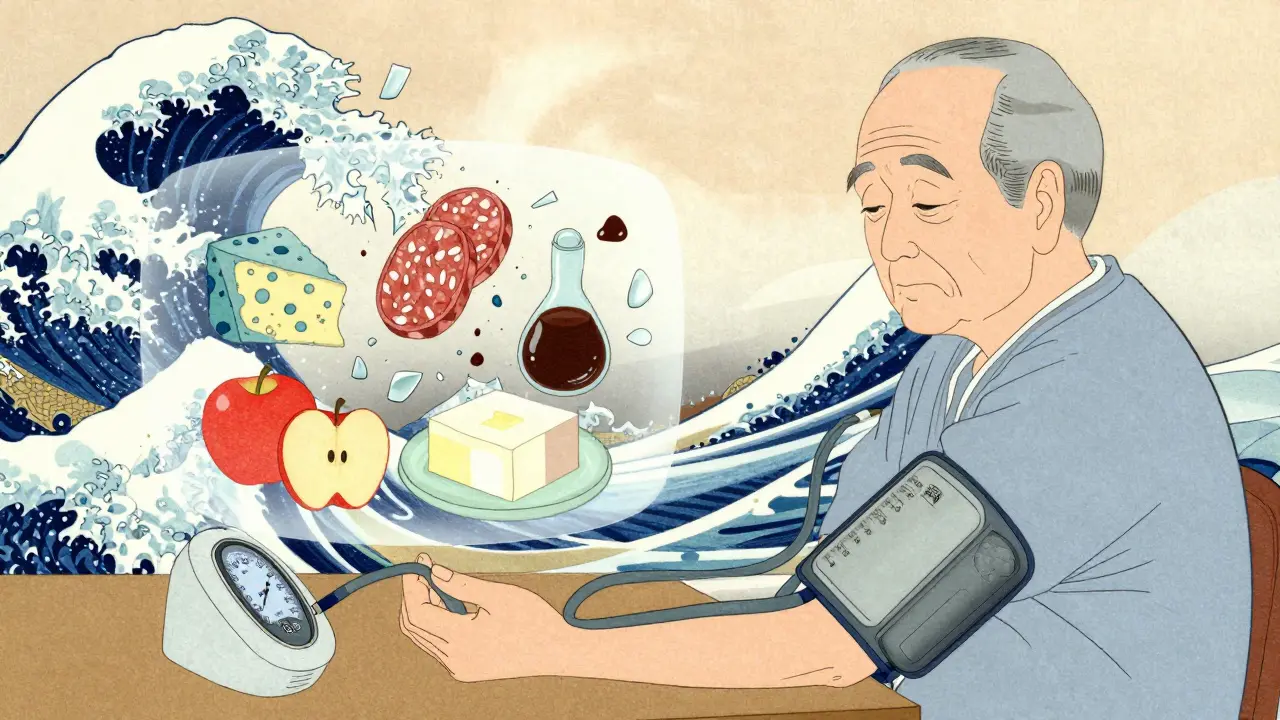
Knowing what to avoid isn’t enough. You need a daily plan.- Buy fresh: Shop weekly. Don’t stockpile. Meat, fish, and cheese should be eaten within 24 hours of purchase.
- Check labels: Avoid anything labeled “aged,” “fermented,” “cured,” or “draft.” Look for “pasteurized” on beer and dairy.
- Keep a food diary: For the first 4 weeks, write down everything you eat and your blood pressure before and 2 hours after meals. This helps spot hidden triggers.
- Use a home blood pressure monitor: Buy one at the pharmacy. Know your baseline. If your systolic pressure jumps above 180 mmHg, act fast.
- Carry an MAOI ID card: Print one from the Mayo Clinic website. Include your meds, doctor’s name, and emergency instructions. Keep it in your wallet.
After the first month, you can slowly test foods. Try a small amount of aged cheese (50g) with no other risky foods. Wait 2 hours. Check your pressure. If it’s normal, you can include it occasionally. Repeat with other foods. This isn’t about fear-it’s about control.
What to Do in an Emergency
A hypertensive crisis hits fast: pounding headache, blurred vision, chest pain, nausea, or sudden high blood pressure. If your systolic reading is over 180 mmHg:- Take 0.2-0.4 mg of nifedipine under your tongue. This is a fast-acting blood pressure reducer.
- Call 911 or go to the ER immediately. Do not wait.
- Tell them you’re on an MAOI. That changes their treatment.
Don’t rely on over-the-counter meds like aspirin or ibuprofen. They won’t help. Only nifedipine or hospital treatment works. Keep a small bottle of sublingual nifedipine at home. Ask your doctor for a prescription.
What Happens After You Stop Taking MAOIs?
You can’t just quit and go back to eating anything. The enzyme monoamine oxidase takes 2-3 weeks to regenerate after stopping irreversible MAOIs. That means your body still can’t break down tyramine. You must keep dietary restrictions for at least 14 days, but 21 days is safer. Don’t rush it. A reaction can still happen weeks after your last pill.Some people switch to moclobemide, a reversible MAO-A inhibitor approved in Canada and Europe. It doesn’t need strict diet rules because it lets tyramine through after a short time. But it’s not available in the U.S. If you’re struggling with the diet, talk to your doctor about alternatives.

Why Do Some Doctors Still Say “No Cheese Ever”?
There’s a divide in the medical community. Some experts, like Dr. David M. Taylor, say the old diet is outdated. Others, like Dr. Alan F. Schatzberg, warn that even one mistake can kill. The truth? Both are right.If you’re new to MAOIs, stick to the conservative list. You don’t know your sensitivity yet. After 4-6 weeks, if your blood pressure stays stable, you can start testing. But if you’ve had a reaction before, or you’re older, or you take other meds like stimulants or cold pills-don’t take chances. The risk isn’t worth it.
The 2023 International Consensus says it best: “Individualize the diet.” There’s no one-size-fits-all. Your body, your meds, your history-all matter.
What’s New in MAOI Research?
Science is catching up. The USDA now has a public database with tyramine levels for over 500 foods. Recent studies show that 68% of foods once banned contain less than 2 mg per 100g when stored properly. Even better, researchers are looking at genetics. People with the MAOA-L gene variant break down tyramine slower. They’re at higher risk. Future testing might tell you exactly how strict you need to be.For now, the American Psychiatric Association’s 2023 guidelines are clear: “Comprehensive dietary education and close monitoring during the first 4 weeks are essential.” That’s your roadmap. Learn. Track. Test. Adjust. Don’t guess.
Can I drink wine while on MAOIs?
Yes, in moderation. Bottled wine is safe. Limit to one 5-ounce glass per day. Avoid tap wine, homebrewed wine, or anything unpasteurized. Beer is riskier-stick to pasteurized, bottled beer, and only one serving per week.
Is chocolate safe on MAOIs?
Yes, up to 30 grams (about one small bar) is considered safe. Dark chocolate has slightly more tyramine than milk chocolate, but it’s still under the 6 mg per meal limit. Avoid chocolate with added nuts or dried fruit if you’re unsure of their storage.
Can I eat soy sauce or tofu?
Avoid soy sauce entirely-it can contain over 100 mg of tyramine per 100g. Tofu is okay in small amounts: limit to 100g (about half a block) no more than twice a week. Choose fresh, refrigerated tofu, not fermented varieties like tempeh or miso.
What if I accidentally eat something risky?
Don’t panic. Check your blood pressure immediately. If it’s below 160 mmHg systolic, monitor for 2 hours. If it rises above 180, take nifedipine and call 911. Even if you feel fine, high blood pressure can be silent. Never assume you’re okay just because you don’t have a headache.
How long do I need to follow the diet?
For as long as you’re on the medication, plus 14-21 days after stopping. The enzyme takes 2-3 weeks to fully recover. Stopping early is dangerous. Even if you feel fine, your body still can’t process tyramine safely during that time.
Are there MAOIs without dietary restrictions?
Yes-transdermal selegiline at 6 mg/24 hours has minimal restrictions. Also, moclobemide (available outside the U.S.) is reversible and doesn’t require strict diet control. But if you’re on oral phenelzine, tranylcypromine, or isocarboxazid, you’re on a high-risk medication. No shortcuts.
Next Steps: What to Do Now
If you’re starting MAOIs:- Get a home blood pressure monitor and learn how to use it.
- Ask your doctor for a prescription for sublingual nifedipine.
- Print an MAOI emergency card and carry it at all times.
- Start a food and pressure diary for the first 4 weeks.
- Shop for fresh food weekly. Avoid bulk, aged, or fermented items.
If you’ve been on MAOIs for a while:
- Review your diet with your doctor. You might be able to relax some rules.
- Test one food at a time-like a small piece of aged cheese-and monitor your pressure.
- Stay updated. New food data comes out every year. Your old list might be too strict-or too loose.
MAOIs work when nothing else does. But they demand respect. You’re not giving up food-you’re learning to eat smarter. With the right plan, you can stay safe and still enjoy life.
Sajith Shams
December 18, 2025 AT 02:51Let’s cut the crap. The 1980s diet rules were pure superstition. I’ve been on phenelzine for seven years. Aged cheddar? I eat it weekly. Draft beer? Twice a month. My BP? Stable as a rock. The real danger isn’t the cheese-it’s the fear-mongering docs who still think you’re a walking time bomb. You don’t need a food diary-you need a backbone.
Glen Arreglo
December 20, 2025 AT 01:37As someone who’s lived in three countries and been on MAOIs for over a decade, I can tell you this: the science has evolved, but the fear hasn’t. In Japan, miso is a staple. In Italy, aged parmesan is lunch. The key isn’t blanket bans-it’s context. Freshness, portion, and combination matter more than the food itself. Education over prohibition.
shivam seo
December 20, 2025 AT 02:20Oh wow, another ‘MAOI safety guide’ from a guy who clearly never left his basement. You think people care about tyramine levels? Most of us are just trying to survive depression without turning into a human pressure cooker. This post reads like a USDA pamphlet written by a robot with anxiety. Just tell people to avoid cheese and move on.
benchidelle rivera
December 20, 2025 AT 23:29While I appreciate the detailed breakdown of tyramine thresholds and food safety parameters, I must emphasize that the emotional burden of dietary restriction is often underestimated. Patients on MAOIs are not merely managing biochemistry-they are navigating identity, social isolation, and the grief of lost culinary freedom. A clinical guide without psychological support is incomplete.
Isabel Rábago
December 21, 2025 AT 17:06People don’t realize that this isn’t just about food-it’s about surrender. You give up spontaneity, you give up trust in your own judgment, you give up the simple joy of sharing a meal with someone who doesn’t have to check a spreadsheet before they take a bite. And for what? A 0.3% chance of a hypertensive crisis? That’s not safety. That’s punishment dressed up as medicine.
Ashley Bliss
December 21, 2025 AT 18:35Every time I see someone say ‘just test it out,’ I want to scream. This isn’t a game of Russian roulette with cheese. It’s not about ‘your body, your rules.’ It’s about a biological mechanism that doesn’t negotiate. One bite of improperly stored salami, one glass of draft beer, and your brain is flooding with norepinephrine like a busted fire hydrant. You don’t get a second chance when your BP hits 220. The fear is real. The danger is silent. And you? You’re just another armchair biochemist thinking you’re special.
Dev Sawner
December 22, 2025 AT 16:44It is imperative to underscore that the assertion regarding the safety of fresh mozzarella and cottage cheese is empirically valid; however, the omission of regional variations in fermentation practices-particularly in South Asian dairy products such as paneer aged beyond 72 hours-renders this guidance incomplete. In certain households in Punjab, paneer is fermented under ambient conditions for up to five days, yielding tyramine concentrations exceeding 18 mg/100g. Thus, blanket categorizations are methodologically unsound.
Moses Odumbe
December 22, 2025 AT 20:45Bro, I just took my first MAOI last week and I’m already eating a slice of blue cheese with a beer. 😎 I’ve got a BP monitor, I’m checking it every 30 mins, and so far so good. If your doctor didn’t tell you this stuff, they’re not keeping up. Also, nifedipine is a lifesaver-got mine from my cousin in Mexico. 🙌 #MAOILife #DontFearTheCheese
Meenakshi Jaiswal
December 23, 2025 AT 07:03Hey, if you’re new to MAOIs, start slow. Don’t panic, but don’t play hero either. I’ve helped 12 patients through this-everyone’s different. One guy ate a little soy sauce and felt fine. Another had a scare from leftover chicken. Your body tells you. Keep the diary. Check your BP. Talk to your doctor. You’re not alone. This is hard, but you’ve got this.
bhushan telavane
December 24, 2025 AT 05:17Back home in Kerala, we eat fermented fish curry every Sunday. My uncle’s been on tranylcypromine for 12 years. He eats it. He’s fine. Maybe the rules don’t fit everywhere. Food isn’t just chemistry-it’s culture. If you’re stable, maybe you don’t need to live like a lab rat.
holly Sinclair
December 25, 2025 AT 10:53What fascinates me is not the tyramine thresholds, but the philosophical tension between autonomy and paternalism in medical ethics. We are told to avoid risk, yet we are denied the agency to calibrate our own thresholds. The very act of quantifying tyramine in milligrams implies a false precision-biology is not a spreadsheet. Is safety defined by the absence of catastrophe, or by the presence of lived experience? And if we reduce human beings to biochemical variables, have we not already lost the essence of care? The 2023 consensus says ‘individualize,’ but the system still screams ‘conform.’ Who are we really protecting here-the patient, or the liability?