Tuberculosis: Understanding Latent Infection, Active Disease, and Treatment Options

Most people who breathe in tuberculosis bacteria never get sick. That’s not because the bacteria disappeared-it’s because their immune system locked them away. This hidden form is called latent TB infection. But for some, those dormant bacteria wake up years later and turn into active, contagious tuberculosis disease. Knowing the difference isn’t just medical trivia-it can save lives.
Latent TB: The Silent Carrier
Latent TB means the bacteria are alive but completely shut down. You feel fine. You don’t cough. You can’t spread it to anyone. Yet, the bacteria are still there, tucked inside granulomas-tiny clusters of immune cells that keep them in check. This isn’t a cure. It’s a stalemate.
About one-quarter of the world’s population has latent TB. That’s nearly 2 billion people. Most will never develop active disease. But for 5 to 10% of those infected, the bacteria eventually break free. The risk spikes dramatically if your immune system weakens. People with untreated HIV are 20 to 30 times more likely to develop active TB. Diabetes, kidney disease, and certain cancer treatments also raise the risk.
How do you know if you have it? Only through testing. A tuberculin skin test (TST) or an interferon-gamma release assay (IGRA) will show a positive result. But a chest X-ray will look normal. No fever. No weight loss. No cough. That’s the trick: you’re infected, but not ill. Many people only find out after being screened for work, immigration, or because someone close to them had active TB.
Active TB: When the Bacteria Wake Up
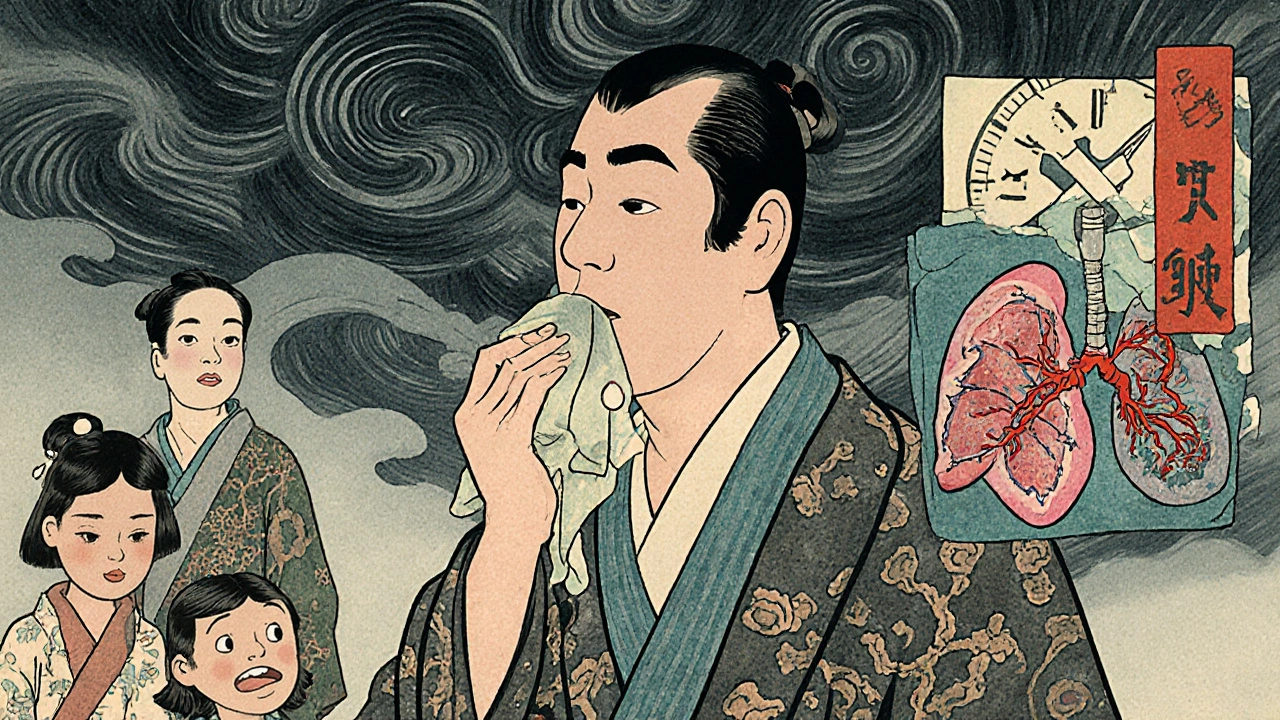
Active TB is when the bacteria start multiplying again. They attack lung tissue, cause inflammation, and trigger symptoms that don’t go away. The most common sign? A cough that lasts longer than three weeks. It starts mild, then gets worse. You might cough up mucus-or blood. Night sweats drench your sheets. You lose weight without trying. Fever comes and goes, usually in the evenings.
These symptoms don’t appear overnight. They creep in over weeks or months. Many people ignore them at first, thinking it’s just a cold or the flu. By the time they see a doctor, the infection has spread. In some cases, TB moves beyond the lungs-to the spine, brain, kidneys, or lymph nodes. That’s called extrapulmonary TB, and it’s harder to diagnose.
Diagnosis requires more than a positive skin test. You need proof the bacteria are active. That means finding them in sputum. A lab test called nucleic acid amplification (NAAT) can detect TB DNA in a cough sample within hours. A sputum culture takes weeks but confirms the strain and checks for drug resistance. A chest X-ray usually shows dark spots or cavities in the lungs-clear signs of damage.
And here’s the critical part: if you have active TB in your lungs, you can spread it. When you cough, sneeze, or even talk, you release tiny droplets into the air. Someone nearby can inhale them. That’s why early detection matters-not just for you, but for everyone around you.
Drug Therapy: The Long Haul
Treating latent TB is simple in theory, hard in practice. The standard is nine months of daily isoniazid. That’s 270 pills. Many people stop taking them after a few weeks because they feel fine. But stopping early means the bacteria survive-and come back stronger.
Thankfully, there are shorter options now. One is three months of weekly isoniazid and rifapentine, taken under direct observation. Another is four months of daily rifampin. These alternatives are just as effective and much easier to finish. The CDC and WHO now recommend them as first-line choices, especially for people who struggle with long regimens.
Active TB is a different beast. It needs a powerful, multi-drug attack. The first two months require four drugs: isoniazid, rifampin, pyrazinamide, and ethambutol. This combo kills the most active bacteria fast. Then, for the next four to seven months, you drop pyrazinamide and ethambutol and keep just isoniazid and rifampin.
Why so many drugs? Because TB bacteria are sneaky. If you use just one, they mutate and become resistant. That’s how multidrug-resistant TB (MDR-TB) forms. MDR-TB needs 9 to 20 months of treatment with second-line drugs that are more toxic, more expensive, and less effective.
Directly observed therapy (DOT) is the gold standard. A nurse or community health worker watches you swallow each pill. It’s not about distrust-it’s about success. Studies show DOT cuts treatment failure and drug resistance by half. In the U.S., DOT is required for all active TB cases.
Side Effects and Monitoring
These drugs aren’t gentle. Isoniazid and rifampin can damage your liver. You’ll need blood tests every few weeks. Signs of trouble? Yellow skin, dark urine, nausea, or pain under your ribs. Stop the meds and call your doctor immediately.
Rifampin turns your urine, sweat, and tears orange. It’s harmless, but startling if you don’t expect it. It also makes birth control pills less effective. Ethambutol can affect vision-rarely, but seriously. You’ll need an eye exam before starting and again after two months.
People with HIV or liver disease need special dosing. Some drugs interact with antiretrovirals. Your doctor will adjust the regimen. Never skip doses or change pills without talking to your provider.

Who Needs Screening?
Not everyone needs a TB test. But if you fall into one of these groups, screening is critical:
- You came from a country where TB is common (India, Indonesia, Philippines, Nigeria, Pakistan)
- You live or work in a high-risk setting (homeless shelters, prisons, nursing homes)
- You’re HIV-positive or have another immune disorder
- You’ve been in close contact with someone who has active TB
- You’re a healthcare worker exposed to patients
Screening is free in many public health clinics. A simple blood test or skin prick can tell you if you’re carrying the bacteria. If you are, treating it now prevents a life-threatening illness later.
The Bigger Picture
TB is not a disease of the past. In 2023, it killed over 1.2 million people worldwide-making it the second-deadliest infectious disease after COVID-19. The good news? We know how to stop it. We have tests. We have drugs. We have proven strategies.
The real challenge isn’t science-it’s access. Millions with latent TB never get tested. People with active TB don’t get consistent care. Drug resistance grows because treatment is interrupted. And stigma keeps people silent.
If you’ve been told you have latent TB, don’t ignore it. Take the pills. Finish the course. You’re not just protecting yourself-you’re protecting your family, your coworkers, your community.
If you have symptoms that won’t go away-a cough, fever, weight loss-see a doctor. Don’t wait. TB is curable. But only if caught early and treated fully.
Can you spread latent TB to others?
No. People with latent TB infection cannot spread the bacteria to others. The bacteria are inactive and contained by the immune system. Only those with active TB disease in the lungs or throat can spread the infection through airborne droplets.
How long does TB treatment take?
Latent TB treatment lasts either 3, 4, or 9 months depending on the drug combo. Active TB requires at least 6 months of multiple antibiotics. The first 2 months use four drugs, then two drugs continue for the rest. Some drug-resistant cases need treatment for 9 to 20 months.
Can TB come back after treatment?
Yes, but it’s rare if treatment is completed correctly. Relapse usually happens when treatment is stopped early or if the strain is drug-resistant. People with weakened immune systems are also at higher risk for reactivation. Completing the full course of medication is the best way to prevent recurrence.
Is there a vaccine for TB?
The BCG vaccine is used in some countries to protect children from severe forms of TB, like TB meningitis. It’s not widely used in the U.S. because it’s not very effective against adult lung TB and can interfere with skin test results. No highly effective vaccine for adults exists yet, but research is ongoing.
What happens if you don’t treat TB?
Latent TB may turn into active disease at any time, especially if your immune system weakens. Active TB, if untreated, destroys lung tissue, spreads to other organs, and can be fatal. It also continues to infect others. Without treatment, up to two-thirds of people with active TB will die.
Are there side effects from TB medications?
Yes. Isoniazid and rifampin can cause liver damage, so regular blood tests are needed. Rifampin turns body fluids orange. Ethambutol may affect vision. Pyrazinamide can cause joint pain or gout. Always report unusual symptoms like yellow skin, nausea, vision changes, or severe fatigue to your doctor right away.
Andrea Jones
November 30, 2025 AT 08:53Just finished my 3-month rifapentine course last month. Felt weird taking pills every week like a robot, but honestly? Worth it. No more nightmares about coughing up blood. You don’t need to be scared-you just need to show up.
Jacob Keil
December 1, 2025 AT 14:03tb is just the governments way to sell more drugs and keep people scared. they dont want you healthy they want you dependent. the real cure is fasting and sunshine. they dont teach you that in med school cause its not profitable. #freedom
Allison Reed
December 2, 2025 AT 04:27Hey Jacob, I get you’re skeptical-but TB isn’t a conspiracy, it’s biology. I had latent TB and took the 3-month combo. No side effects, no drama. Just peace of mind. My grandma had active TB in the 80s-she didn’t make it because they didn’t have these options then. We’re lucky.
Rosy Wilkens
December 2, 2025 AT 12:12Did you know the WHO is funded by pharmaceutical conglomerates? The entire TB narrative is engineered to push expensive, toxic regimens. IGRAs are unreliable-they cross-react with BCG vaccines. And rifampin? It’s a known hepatotoxin. Why are we not discussing natural immunity? Why is detoxification ignored? This is medical colonization disguised as care.
Evelyn Salazar Garcia
December 4, 2025 AT 01:09Why do we even test people from India? They’re just bringing it here. Let them handle their own TB.
Clay Johnson
December 4, 2025 AT 07:48Immunity is a conversation between host and pathogen. Latency is not failure. It’s coexistence. The drugs are a blunt instrument. We treat infection like war. Maybe we should treat it like diplomacy.
Jermaine Jordan
December 5, 2025 AT 02:01Let me tell you something-TB doesn’t care if you’re rich or poor, American or Indian. It only cares if you’re alive long enough to finish your pills. I’ve seen patients die because they missed one dose. One. Dose. This isn’t just medicine-it’s a lifeline. Don’t take it lightly.
Chetan Chauhan
December 6, 2025 AT 06:49u all r so naive. in india we dont even have access to 1st line drugs. why are u talking abt 3 month regimens? we r lucky if we get isoniazid. also rifampin turns urine orange? lol my aunt got black urine. she died. u think that's normal?
Phil Thornton
December 7, 2025 AT 01:33My coworker had latent TB. Took the pills. Now she’s fine. No drama. Just did it.
Pranab Daulagupu
December 7, 2025 AT 22:58As someone from a high-burden country, I can say this: early screening saves lives. My cousin was diagnosed via workplace IGRA. Started treatment. No hospitalization. No stigma. Just a 3-month course. We need more programs like this. Not less.
Barbara McClelland
December 8, 2025 AT 09:55Just wanted to say-this post was so clear. I showed it to my mom who’s a nurse. She said, 'Finally, someone explains it without jargon.' I’ve been telling people for years that latent TB isn’t nothing-it’s a ticking clock. But nobody listens. Thanks for putting this out there.
Alexander Levin
December 8, 2025 AT 12:09They’re putting TB drugs in the water. That’s why everyone’s getting tested. 🤫💧
Ady Young
December 9, 2025 AT 21:42I work in a clinic and we’ve had a 40% increase in latent TB referrals since last year. Most are young adults who came here for school. They’re scared, but they show up. They take the meds. They get better. It’s not glamorous, but it works. We need more funding-not more fear.
Justina Maynard
December 10, 2025 AT 09:34I’m the kind of person who forgets to take vitamins, so I took my TB meds with my morning coffee. One day, I looked in the mirror and my face looked like a pumpkin. Turns out, rifampin turns your sweat orange. I thought I was dying. Called my doctor. She laughed. Said, 'That’s normal. You’re not a ghost-you’re just chemically lit.' Now I wear dark shirts. And I finished the course. No regrets. Just weird stories to tell at parties.