Psychological Strategies to Manage Anxiety About Medication Side Effects

Medication Side Effect Timeline Calculator
Find out how long your side effects might last
This tool estimates the typical duration of common medication side effects based on clinical studies. Remember, these are averages - individual experiences may vary. Always consult your doctor about your specific situation.
Your Side Effect Timeline
Typically occurs between days 3-7
Most people see major improvement by day 14-21
70-80% of side effects resolve within 4 weeks
Practical management tips
- For nausea: Take with food, sip cool water, or suck on hard candy (reduces severity by up to 65%)
- For insomnia: Switch to morning dosing (reduces sleep problems from 35% to 15%)
- For fatigue: Give your body 2-4 weeks to adjust (it's not laziness)
- For dizziness: Stand up slowly, stay hydrated
It’s not uncommon to feel nervous about starting a new medication. You’ve read the list of possible side effects-nausea, dizziness, insomnia, weight gain-and suddenly your body starts noticing every little sensation. A headache? Must be the pill. A racing heart? That’s definitely a reaction. You’re not crazy. You’re not weak. You’re just human. And you’re not alone. About 60% of people on long-term medications report anxiety about side effects, even when those side effects are mild or temporary.
Why Your Brain Turns Normal Sensations Into Danger Signs
Your brain is wired to protect you. When you hear a new drug might cause fatigue or sleep problems, your mind doesn’t just file that away. It starts scanning your body for signs of trouble. This isn’t irrational-it’s evolutionary. But in the modern world, this system often overfires. You take an SSRI for anxiety, and within days, you feel a little tired. Your brain doesn’t say, “This is normal.” It says, “This is dangerous. The drug is harming you.” This is called the nocebo effect. It’s the opposite of the placebo effect. Instead of positive expectations making you feel better, negative expectations make you feel worse. Studies show that when patients are told a medication might cause nausea, more of them report nausea-even if they’re taking a sugar pill. The expectation itself creates the symptom.Most Side Effects Are Temporary (And Here’s When They Fade)
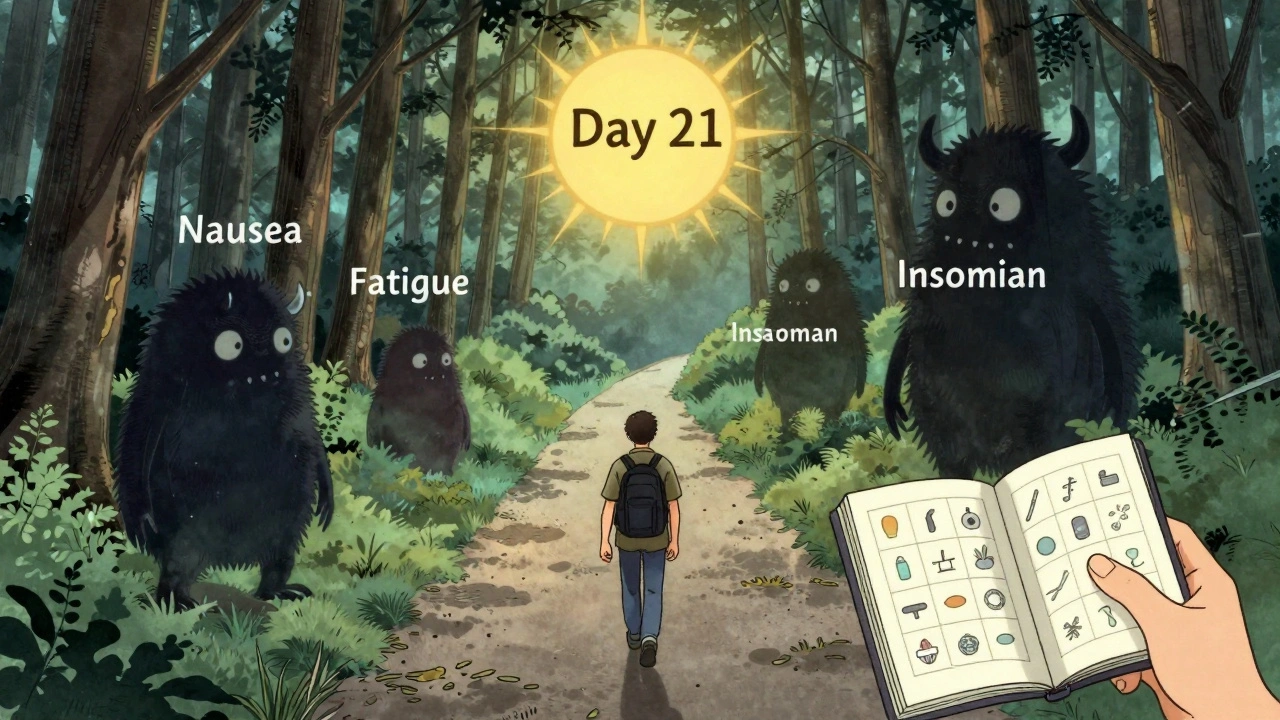
One of the biggest mistakes people make is quitting medication too soon because they assume side effects will last forever. They don’t. For most antidepressants and anxiety medications, the worst side effects peak between days 3 and 7 and fade significantly by day 14 to 21. - Nausea: Takes 1-2 weeks to improve. Taking the pill with food, sipping cool water, or sucking on hard candy reduces severity by up to 65%. - Insomnia: If you’re taking an SSRI at night, switching to morning dosing cuts sleep problems from 35% to 15% in most people. - Fatigue: Usually lifts within 2-4 weeks. It’s not laziness-it’s your nervous system adjusting. - Dizziness: Often disappears after 10-14 days. Stand up slowly. Drink water. Your body recalibrates. The Mayo Clinic found that 70-80% of common antidepressant side effects resolve within a month. If you quit before then, you’re not giving your body a fair shot. You’re also missing out on the real benefit: the medication working as intended.Cognitive Behavioral Therapy (CBT): The Most Proven Tool
The most effective psychological strategy for medication anxiety is CBT. Not because it’s trendy, but because it works. A 2022 meta-analysis showed that patients using CBT to manage medication fears were 58% less likely to stop their treatment early. CBT doesn’t tell you to “just relax.” It teaches you to question your thoughts. Here’s how:- Identify the thought: “If I feel dizzy, this drug is damaging my brain.”
- Ask for evidence: “Have I ever had brain damage from dizziness before? Has my doctor ever said this is dangerous?”
- Test the probability: “Out of 100 people on this medication, how many actually have serious side effects? Less than 2%.”
- Replace it: “Dizziness is uncomfortable, but it’s temporary. It’s not a sign of harm-it’s a sign my body is adapting.”
Acceptance and Commitment Therapy (ACT): When CBT Feels Too Much
Some people find CBT too analytical. If you’re tired of arguing with your thoughts, ACT might be a better fit. Instead of fighting anxiety, ACT teaches you to make space for it. Think of it like this: You’re sitting in a car. The anxiety about side effects is a loud passenger in the backseat. CBT tries to quiet them. ACT says, “Okay, they’re loud. But I’m still driving.” You don’t need to eliminate the fear. You just need to keep moving forward-toward your goals: feeling better, sleeping through the night, being present with your family. ACT has shown similar results to CBT in reducing medication discontinuation, with better long-term results. At six months, 72% of ACT users were still on their medication, compared to 65% for CBT.Simple Tools You Can Use Today
You don’t need a therapist to start managing medication anxiety. Here are three practical tools anyone can use:- The Two-Week Rule: Commit to taking your medication for 14 days before deciding if it’s right for you. Use those two weeks to practice coping skills, not to panic.
- Side Effect Journal: Write down what you feel, when you feel it, and what you were doing. After a week, you’ll see patterns. “I felt dizzy every time I stood up too fast”-not “the drug is making me sick.”
- Grounding Technique: When anxiety spikes, use the 5-4-3-2-1 method: Name 5 things you see, 4 you can touch, 3 you hear, 2 you smell, 1 you taste. This pulls your brain out of panic mode and into the present.
Why Doctors Don’t Always Talk About This
It’s frustrating when your doctor says, “It’s just side effects,” and walks away. You feel dismissed. You’re not alone. Only 35% of primary care clinics offer formal psychological support for medication anxiety, according to the 2023 NIMH provider survey. Many doctors assume patients will read the pamphlet and figure it out. But here’s the truth: If you’re anxious, reading a pamphlet isn’t enough. You need guidance. You need someone to help you separate real danger from fear. If your doctor doesn’t offer this, ask: “Can you recommend a therapist who works with medication anxiety?” Or ask for a referral to a behavioral health specialist. You’re not asking for extra help-you’re asking for better care.
The Rise of Digital Tools
In March 2024, the FDA approved the first digital therapeutic app, SideEffectCope, designed specifically to manage medication anxiety using CBT techniques. In clinical trials, users saw a 53% drop in treatment discontinuation. The app walks you through thought-challenging exercises, tracks your symptoms, and reminds you of timelines for side effect resolution. Self-guided workbooks like Dr. Martin Antony’s Managing Medication Anxiety also work. When used consistently over 8 weeks, they’re 55% effective at reducing fear and improving adherence. You don’t need to wait for a therapist. Start today. Download an app. Buy a journal. Use the tools that are already available.When to Worry-And When to Keep Going
Not every side effect is harmless. If you experience:- Severe chest pain or irregular heartbeat
- Suicidal thoughts or worsening depression
- High fever, stiff muscles, confusion (signs of serotonin syndrome)
What’s Next? You Have More Power Than You Think
Medication anxiety isn’t a weakness. It’s a signal. Your brain is trying to protect you. The goal isn’t to ignore it. It’s to understand it. To respond to it with facts, not fear. You don’t have to suffer through side effects alone. You don’t have to quit because you felt bad for a week. You don’t have to believe every uncomfortable sensation is a catastrophe. With the right tools-CBT, ACT, journaling, grounding, and time-you can take back control. You can stay on the medication that could change your life. And you can do it without letting fear call the shots.Start small. Pick one tool. Try it for two weeks. See what happens. Your future self will thank you.
How long do medication side effects usually last?
Most common side effects like nausea, dizziness, and fatigue peak within the first week and improve significantly by day 14 to 21. For SSRIs and similar medications, 70-80% of side effects resolve within 2-4 weeks of consistent use. If symptoms persist beyond four weeks or worsen, consult your doctor.
Can anxiety about side effects make the side effects worse?
Yes. This is called the nocebo effect. When you expect a side effect, your brain can trigger physical symptoms-even if the medication isn’t causing them. Studies show that patients told a drug might cause nausea report it more often than those told it’s unlikely. Managing anxiety reduces this effect.
Is it normal to want to quit medication because of side effects?
Yes, it’s very common. About 60% of people on long-term medications feel this way. But quitting too soon often means missing out on the benefits. Most side effects are temporary, and the real improvement from the medication usually kicks in after the initial discomfort fades.
What’s the difference between CBT and ACT for medication anxiety?
CBT focuses on changing negative thoughts by challenging them with evidence. ACT focuses on accepting uncomfortable thoughts and feelings without fighting them, while still taking action toward your goals. Both are effective, but ACT may be easier if you’re tired of arguing with your mind.
Are there apps that can help with medication anxiety?
Yes. In 2024, the FDA approved the first digital therapeutic app, SideEffectCope, designed specifically to reduce medication anxiety using CBT techniques. It’s been shown to cut treatment discontinuation by 53%. Other self-guided workbooks and mindfulness apps also help when used consistently.
When should I contact my doctor about side effects?
Contact your doctor immediately if you experience chest pain, irregular heartbeat, suicidal thoughts, high fever, stiff muscles, or confusion. These are rare but serious signs. For common side effects like nausea or fatigue, give them 2-4 weeks to improve before calling-unless they’re unbearable.
Can I manage medication anxiety without therapy?
Yes. Many people successfully manage medication anxiety using self-guided tools: journaling symptoms, using the two-week rule, practicing grounding techniques, or using apps like SideEffectCope. Therapy helps if you need more support, but it’s not the only path.
People who stick with their medication through the tough first weeks are the ones who see real change. Not because they’re stronger. But because they learned how to listen to their body without letting fear speak for it.
Makenzie Keely
December 3, 2025 AT 13:15Let me tell you-this article is a lifeline. I was ready to quit my SSRI after three days because I felt ‘off’-like my brain was swimming in molasses. But then I read the part about the nocebo effect-and I realized I was screaming at myself for feeling normal side effects. I started the two-week rule, kept a journal, and guess what? The nausea vanished when I took it with food. I’m now 14 months in and actually sleeping through the night. You’re not broken. You’re adjusting.
Vincent Soldja
December 5, 2025 AT 05:38Interesting. But most people don’t have time for journals or apps. Just take the pill or don’t. Life’s too short to overthink a side effect.
Gavin Boyne
December 5, 2025 AT 11:52Oh wow. A 53% drop in discontinuation? So the FDA approved an app that basically says ‘breathe and wait’? And we call this innovation? Next they’ll patent a reminder to drink water when you’re dizzy. At least the placebo effect had a sense of humor.
Charles Moore
December 7, 2025 AT 10:17As someone who’s been on meds for 12 years, I want to say this gently: you’re not alone. The fear is real, but it’s not the whole story. I used ACT when CBT felt like arguing with a ghost. I stopped trying to silence the anxiety and just let it ride in the backseat while I drove toward my goals. It didn’t fix everything-but it let me stay on track. You don’t need to be brave. Just persistent.
Rashi Taliyan
December 8, 2025 AT 03:19My mother took antidepressants for 20 years and never once complained-even when she felt like her body was betraying her. She said, ‘The pain is temporary, but peace is forever.’ I cried reading this. Thank you for giving voice to what so many of us suffer through silently.
Kara Bysterbusch
December 10, 2025 AT 02:05It is truly remarkable how the nocebo effect operates as a self-fulfilling prophecy, rooted in the intricate interplay between cognitive expectation and somatic perception. The data presented here-particularly the 70–80% resolution rate within four weeks-is not merely statistically significant; it is profoundly humanizing. I would strongly encourage all readers to engage with the SideEffectCope app, which, in conjunction with a structured journaling practice, offers a scientifically validated pathway toward reclaiming agency over one’s physiological experience. One must not conflate discomfort with danger.
Albert Essel
December 10, 2025 AT 09:55I get why people quit. I did too. But I came back after six months-this time with a therapist who didn’t just nod and say ‘it’ll pass.’ She taught me to ask: ‘Is this symptom telling me to stop-or telling me I’m scared?’ That shift changed everything. I’m still on the med. I’m still anxious sometimes. But now I know: anxiety doesn’t mean danger. It just means I’m trying.
vinoth kumar
December 11, 2025 AT 06:57I’m from India and we don’t talk about this stuff. My cousin stopped her meds because she thought the dizziness meant her brain was rotting. She didn’t know it was normal. I’m sharing this with my family. Thank you for writing this. Maybe someone will read it before they quit.